






Diese Website verwendet Cookies und ähnliche Technologien. Dabei handelt es sich um kleine Textdateien, die auf eurem Computer gespeichert und ausgelesen werden. Indem ihr auf "Alles akzeptieren" klickt, stimmt ihr der Verarbeitung von Daten, der Erstellung und Verarbeitung von individuellen Nutzungsprofilen über Websites und über Partner und Geräte hinweg sowie der Übermittlung eurer Daten an Drittanbieter zu, die eure Daten teilweise in Ländern außerhalb der Europäischen Union verarbeiten (GDPR Art. 49). Einzelheiten hierzu findet ihr in den Datenschutzhinweisen. Die Daten werden für Analysen und für eigene Zwecke Dritter verwendet. Weitere Informationen, auch über die Datenverarbeitung durch Drittanbieter und die Möglichkeit des Widerrufs, findet ihr in den Einstellungen und in unseren Datenschutzhinweisen. Hier könnt ihr mit den notwendigen Tools fortfahren.
- Verlag: Springer, Berlin
- Autor: Eduardo Dorrego López
- Artikel-Nr.: KNV96223194
- ISBN: 9783031243622
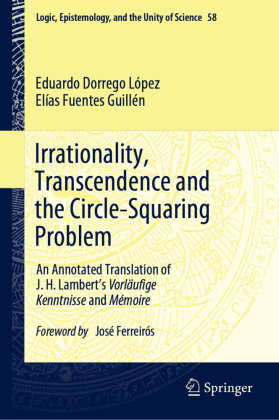
This publication includes an unabridged and annotated translation of two works by Johann Heinrich Lambert (1728-1777) written in the 1760s: Vorläufige Kenntnisse für die, so die Quadratur und Rectification des Circuls suchen and Mémoire sur quelques propriétés remarquables des quantités transcendentes circulaires et logarithmiques. The translations are accompanied by a contextualised study of each of these works and provide an overview of Lambert's contributions, showing both the background and the influence of his work. In addition, by adopting a biographical approach, it allows readers to better get to know the scientist himself.
Lambert was a highly relevant scientist and polymath in his time, admired by the likes of Kant, who despite having made a wide variety of contributions to different branches of knowledge, later faded into an undeserved secondary place with respect to other scientists of the eighteenth century. In mathematics, in particular, he is famous for his research on non-Euclidean geometries, although he is likely best known for having been the first who proved the irrationality of pi. In his Mémoire, he conducted one of the first studies on hyperbolic functions, offered a surprisingly rigorous proof of the irrationality of pi, established for the first time the modern distinction between algebraic and transcendental numbers, and based on such distinction, he conjectured the transcendence of pi and therefore the impossibility of squaring the circle.