






Diese Website verwendet Cookies und ähnliche Technologien. Dabei handelt es sich um kleine Textdateien, die auf eurem Computer gespeichert und ausgelesen werden. Indem ihr auf "Alles akzeptieren" klickt, stimmt ihr der Verarbeitung von Daten, der Erstellung und Verarbeitung von individuellen Nutzungsprofilen über Websites und über Partner und Geräte hinweg sowie der Übermittlung eurer Daten an Drittanbieter zu, die eure Daten teilweise in Ländern außerhalb der Europäischen Union verarbeiten (GDPR Art. 49). Einzelheiten hierzu findet ihr in den Datenschutzhinweisen. Die Daten werden für Analysen und für eigene Zwecke Dritter verwendet. Weitere Informationen, auch über die Datenverarbeitung durch Drittanbieter und die Möglichkeit des Widerrufs, findet ihr in den Einstellungen und in unseren Datenschutzhinweisen. Hier könnt ihr mit den notwendigen Tools fortfahren.
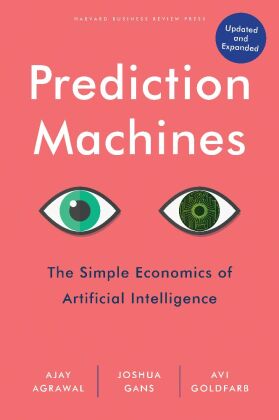
- Verlag: Harvard Business Review Press
- Autor: Ajay Agrawal
- Artikel-Nr.: KNV95922381
- ISBN: 9781647824679
Named one of "The five best books to understand AI" by The Economist
The impact AI will have is profound, but the economic framework for understanding it is surprisingly simple.
Artificial intelligence seems to do the impossible, magically bringing machines to life-driving cars, trading stocks, and teaching children. But facing the sea change that AI brings can be paralyzing. How should companies set strategies, governments design policies, and people plan their lives for a world so different from what we know? In the face of such uncertainty, many either cower in fear or predict an impossibly sunny future.
But in Prediction Machines, three eminent economists recast the rise of AI as a drop in the cost of prediction. With this masterful stroke, they lift the curtain on the AI-is-magic hype and provide economic clarity about the AI revolution as well as a basis for action by executives, policy makers, investors, and entrepreneurs.
In this new, updated edition, the authors illustrate how, when AI is framed as cheap prediction, its extraordinary potential becomes clear:
- Prediction is at the heart of making decisions amid uncertainty. Our businesses and personal lives are riddled with such decisions.
- Prediction tools increase productivity-operating machines, handling documents, communicating with customers.
- Uncertainty constrains strategy. Better prediction creates opportunities for new business strategies to compete.
The authors reset the context, describing the striking impact the book has had and how its argument and its implications are playing out in the real world. And in new material, they explain how prediction fits into decision-making processes and how foundational technologies such as quantum computing will impact business choices.
Penetrating, insightful, and practical, Prediction Machines will help you navigate the changes on the horizon.