






Diese Website verwendet Cookies und ähnliche Technologien. Dabei handelt es sich um kleine Textdateien, die auf eurem Computer gespeichert und ausgelesen werden. Indem ihr auf "Alles akzeptieren" klickt, stimmt ihr der Verarbeitung von Daten, der Erstellung und Verarbeitung von individuellen Nutzungsprofilen über Websites und über Partner und Geräte hinweg sowie der Übermittlung eurer Daten an Drittanbieter zu, die eure Daten teilweise in Ländern außerhalb der Europäischen Union verarbeiten (GDPR Art. 49). Einzelheiten hierzu findet ihr in den Datenschutzhinweisen. Die Daten werden für Analysen und für eigene Zwecke Dritter verwendet. Weitere Informationen, auch über die Datenverarbeitung durch Drittanbieter und die Möglichkeit des Widerrufs, findet ihr in den Einstellungen und in unseren Datenschutzhinweisen. Hier könnt ihr mit den notwendigen Tools fortfahren.
- Verlag: Springer, Berlin
- Autor: Dinesh Kumar Srivastava
- Artikel-Nr.: KNV96251799
- ISBN: 9789811623417
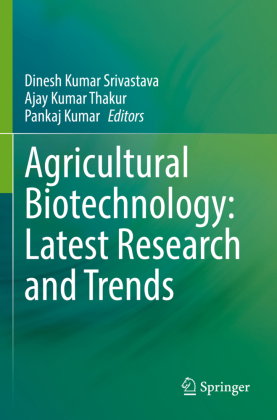
This book caters to the need of researchers working in the ever-evolving field of agricultural biotechnology. It discusses and provides in-depth information about latest advancements happening in this field. The book discusses evolution of plant tissue culture techniques, development of doubled haploids technology, role of recombinant-DNA technology in crop improvement. It also provides an insight into the global status of genetically modified crops, use of RNAi technology and mi-RNAs in plant improvement. Chapters are also dedicated for different branches of 'omics' science including genomics, bioinformatics, proteomics, metabolomics and phenomics along with the use of molecular markers in tagging and mapping of various genes/QTLs of agronomic importance. This book also covers the role of enzymes and microbes in agriculture in productivity enhancement. It is of interest to teachers, researchers of biotechnology and agriculture scientists. Also the book serves as additional readingmaterial for undergraduate and postgraduate students of biotechnology, agriculture, horticulture, forestry, ecology, soil science, and environmental sciences. National and international biotechnologists and agricultural scientists will also find this to be a useful read.