






Diese Website verwendet Cookies und ähnliche Technologien. Dabei handelt es sich um kleine Textdateien, die auf eurem Computer gespeichert und ausgelesen werden. Indem ihr auf "Alles akzeptieren" klickt, stimmt ihr der Verarbeitung von Daten, der Erstellung und Verarbeitung von individuellen Nutzungsprofilen über Websites und über Partner und Geräte hinweg sowie der Übermittlung eurer Daten an Drittanbieter zu, die eure Daten teilweise in Ländern außerhalb der Europäischen Union verarbeiten (GDPR Art. 49). Einzelheiten hierzu findet ihr in den Datenschutzhinweisen. Die Daten werden für Analysen und für eigene Zwecke Dritter verwendet. Weitere Informationen, auch über die Datenverarbeitung durch Drittanbieter und die Möglichkeit des Widerrufs, findet ihr in den Einstellungen und in unseren Datenschutzhinweisen. Hier könnt ihr mit den notwendigen Tools fortfahren.
- Verlag: Springer, Berlin
- Autor: Maria Ulan
- Artikel-Nr.: KNV96256869
- ISBN: 9783031256653
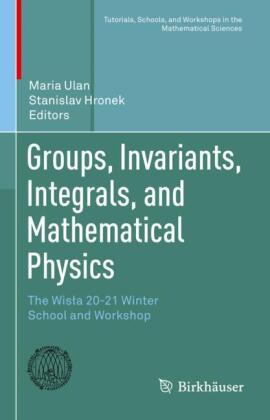
This volume presents lectures given at the Wisla 20-21 Winter School and Workshop: Groups, Invariants, Integrals, and Mathematical Physics, organized by the Baltic Institute of Mathematics. The lectures were dedicated to differential invariants - with a focus on Lie groups, pseudogroups, and their orbit spaces - and Poisson structures in algebra and geometry and are included here as lecture notes comprising the first two chapters. Following this, chapters combine theoretical and applied perspectives to explore topics at the intersection of differential geometry, differential equations, and category theory. Specific topics covered include:
- The multisymplectic and variational nature of Monge-Ampère equations in dimension four
- Integrability of fifth-order equations admitting a Lie symmetry algebra
- Applications of the van Kampen theorem for groupoids to computation of homotopy types of striped surfaces
- A geometric framework to compare classical systemsof PDEs in the category of smooth manifolds
Groups, Invariants, Integrals, and Mathematical Physics is ideal for graduate students and researchers working in these areas. A basic understanding of differential geometry and category theory is assumed.