






Diese Website verwendet Cookies und ähnliche Technologien. Dabei handelt es sich um kleine Textdateien, die auf eurem Computer gespeichert und ausgelesen werden. Indem ihr auf "Alles akzeptieren" klickt, stimmt ihr der Verarbeitung von Daten, der Erstellung und Verarbeitung von individuellen Nutzungsprofilen über Websites und über Partner und Geräte hinweg sowie der Übermittlung eurer Daten an Drittanbieter zu, die eure Daten teilweise in Ländern außerhalb der Europäischen Union verarbeiten (GDPR Art. 49). Einzelheiten hierzu findet ihr in den Datenschutzhinweisen. Die Daten werden für Analysen und für eigene Zwecke Dritter verwendet. Weitere Informationen, auch über die Datenverarbeitung durch Drittanbieter und die Möglichkeit des Widerrufs, findet ihr in den Einstellungen und in unseren Datenschutzhinweisen. Hier könnt ihr mit den notwendigen Tools fortfahren.
- Verlag: Springer, Berlin
- Autor: José A. Méndez Dot
- Artikel-Nr.: KNV96256690
- ISBN: 9783031254932
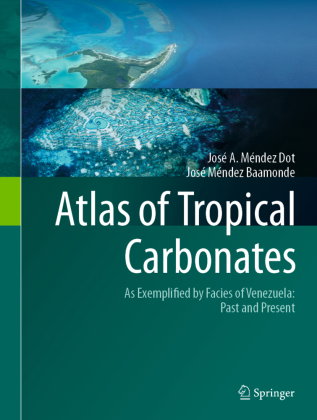
This book is based on more than 40 years of research in the area of carbonate sediments and rocks of different geological ages in Venezuela. It includes examples from the Permian age (more than 270 million years ago) to the Quaternary environments belonging to modern ecosystems located on the southeast and northeast margins of the Caribbean Sea.
It focuses on the description, mainly petrographic, of carbonate sediments and rocks in continental Venezuela, and its modern carbonate systems, both in the Caribbean reef islands and archipelagos and the Atlantic continental shelve and slope. This includes the age, type of sedimentary environments (both present and the past), facies and microfacies, texture and fabric, identification and description of skeletal and non-skeletal grains (e.g. foraminifera and ooids, respectively), and other constituents (e.g., micrite, dolomite crystals, cements). It also covers porosity types and their primary or secondary origin, diagenetic processes, and some of the most significant non-carbonate minerals common in carbonate rocks (e.g., phosphate, pyrite, glauconite). Furthermore, it offers exceptional examples of petroleum source rocks (Cretaceous black shales) and carbonate reservoirs (of Cretaceous, Oligocene and Miocene ages), with over 650 photographs (panoramic and close up on kilometer, meter and centimeter scales) and photomicrographs taken with a polarized microscope (on millimeter and micrometer scales).
This book, consisting of 23 chapters, is not only an atlas of tropical carbonates of Venezuela. The first two chapters comprise an updated review of the geology of Venezuela (from Late Paleozoic to Present) and its petroliferous basins. Furthermore, each photographic chapter is preceded by an introduction. These documents, in which both generalities and specifications about the main subject matter are discussed, have been written with the intention of being general references for carbonate rocks and sediments (not only for carbonate facies of Venezuela). In addition, in the supplementary material (Appendix I and II) the authors develop the concepts of Marine Carbonate Factories, Grain Associations, and Calcite-Aragonite Seas, and place emphasis on how they apply those concepts to ancient and modern carbonate facies of Venezuela.
The authors have intended this book for professors, researchers, and graduated students in the area of Geosciences, especially Geology and Geochemistry, and whose investigations are focused on carbonate sedimentology and stratigraphy. It is also a valuable resource for oil industry professionals, as well as biologists and ecologists who are interested in the study of modern coral reefs.