






Diese Website verwendet Cookies und ähnliche Technologien. Dabei handelt es sich um kleine Textdateien, die auf eurem Computer gespeichert und ausgelesen werden. Indem ihr auf "Alles akzeptieren" klickt, stimmt ihr der Verarbeitung von Daten, der Erstellung und Verarbeitung von individuellen Nutzungsprofilen über Websites und über Partner und Geräte hinweg sowie der Übermittlung eurer Daten an Drittanbieter zu, die eure Daten teilweise in Ländern außerhalb der Europäischen Union verarbeiten (GDPR Art. 49). Einzelheiten hierzu findet ihr in den Datenschutzhinweisen. Die Daten werden für Analysen und für eigene Zwecke Dritter verwendet. Weitere Informationen, auch über die Datenverarbeitung durch Drittanbieter und die Möglichkeit des Widerrufs, findet ihr in den Einstellungen und in unseren Datenschutzhinweisen. Hier könnt ihr mit den notwendigen Tools fortfahren.
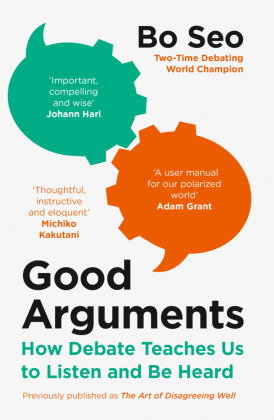
- Verlag: HarperCollins UK
- Autor: Bo Seo
- Artikel-Nr.: KNV96277110
- ISBN: 9780008498696
How do you win an argument? How do you disagree without hard feelings? How do you debate in a way that moves the topic forward to an answer?
Arguments matter, because we have them every day. We do it with loved ones and at work, over which restaurant to go to and which social viewpoint is right or fair. We trust the people we elect to argue on our behalf. We trust the news to dissect the arguments different parties are proposing. We have a system of justice which trusts the better argument will win out.
Once, argument was taught and celebrated as a fundamental part of being a good citizen. But it isn't anymore, and often we struggle to argue without furthering divisions, without hurt feelings or a useful progression of ideas at stake.
As a two-time world debate champion, Bo Seo has made a career out of arguing well. In this book, he provides the reader with an unforgettable toolkit to improve their own disagreements, so that the outcome of having an argument is better than not having it at all.
A thrilling adventure into the past and present of competitive debate, Good Arguments proves that good-faith disagreements can enrich our friendships, workplaces, and democracies - and in the process, our world.
Previously published as The Art of Disagreeing Well