






Diese Website verwendet Cookies und ähnliche Technologien. Dabei handelt es sich um kleine Textdateien, die auf eurem Computer gespeichert und ausgelesen werden. Indem ihr auf "Alles akzeptieren" klickt, stimmt ihr der Verarbeitung von Daten, der Erstellung und Verarbeitung von individuellen Nutzungsprofilen über Websites und über Partner und Geräte hinweg sowie der Übermittlung eurer Daten an Drittanbieter zu, die eure Daten teilweise in Ländern außerhalb der Europäischen Union verarbeiten (GDPR Art. 49). Einzelheiten hierzu findet ihr in den Datenschutzhinweisen. Die Daten werden für Analysen und für eigene Zwecke Dritter verwendet. Weitere Informationen, auch über die Datenverarbeitung durch Drittanbieter und die Möglichkeit des Widerrufs, findet ihr in den Einstellungen und in unseren Datenschutzhinweisen. Hier könnt ihr mit den notwendigen Tools fortfahren.
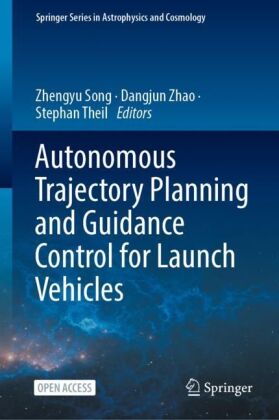
- Verlag: Springer, Berlin
- Autor: Zhengyu Song
- Artikel-Nr.: KNV96314557
- ISBN: 9789819906154
This open access book highlights the autonomous and intelligent flight control of future launch vehicles for improving flight autonomy to plan ascent and descent trajectories onboard, and autonomously handle unexpected events or failures during the flight.
Since the beginning of the twenty-first century, space launch activities worldwide have grown vigorously. Meanwhile, commercial launches also account for the booming trend. Unfortunately, the risk of space launches still exists and is gradually increasing in line with the rapidly rising launch activities and commercial rockets. In the history of space launches, propulsion and control systems are the two main contributors to launch failures. With the development of information technologies, the increase of the functional density of hardware products, the application of redundant or fault-tolerant solutions, and the improvement of the testability of avionics, the launch losses caused by control systems exhibita downward trend, and the failures induced by propulsion systems become the focus of attention. Under these failures, the autonomous planning and guidance control may save the missions.
This book focuses on the latest progress of relevant projects and academic studies of autonomous guidance, especially on some advanced methods which can be potentially real-time implemented in the future control system of launch vehicles. In Chapter 1, the prospect and technical challenges are summarized by reviewing the development of launch vehicles. Chapters 2 to 4 mainly focus on the flight in the ascent phase, in which the autonomous guidance is mainly reflected in the online planning. Chapters 5 and 6 mainly discuss the powered descent guidance technologies. Finally, since aerodynamic uncertainties exert a significant impact on the performance of the ascent / landing guidance control systems, the estimation of aerodynamic parameters, which are helpful to improve flight autonomy, is discussed in Chapter 7.
The book serves as a valuable reference for researchers and engineers working on launch vehicles. It is also a timely source of information for graduate students interested in the subject.