






Diese Website verwendet Cookies und ähnliche Technologien. Dabei handelt es sich um kleine Textdateien, die auf eurem Computer gespeichert und ausgelesen werden. Indem ihr auf "Alles akzeptieren" klickt, stimmt ihr der Verarbeitung von Daten, der Erstellung und Verarbeitung von individuellen Nutzungsprofilen über Websites und über Partner und Geräte hinweg sowie der Übermittlung eurer Daten an Drittanbieter zu, die eure Daten teilweise in Ländern außerhalb der Europäischen Union verarbeiten (GDPR Art. 49). Einzelheiten hierzu findet ihr in den Datenschutzhinweisen. Die Daten werden für Analysen und für eigene Zwecke Dritter verwendet. Weitere Informationen, auch über die Datenverarbeitung durch Drittanbieter und die Möglichkeit des Widerrufs, findet ihr in den Einstellungen und in unseren Datenschutzhinweisen. Hier könnt ihr mit den notwendigen Tools fortfahren.
- Verlag: Penguin Random House
- Autor: Robin DiAngelo
- Artikel-Nr.: KNV95914964
- ISBN: 9780807016091
I was taught to treat everyone the same. I don t see color. My parents voted for Obama. When white people have the opportunity to think and talk about race and racism, they more often than not don t know how.
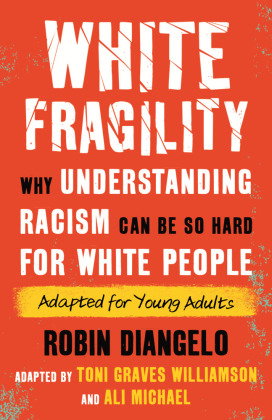
In this adaptation of Dr. Robin DiAngelo s best-selling book White Fragility, anti-racist educators Toni Graves Williamson and Ali Michael explain the concept of systemic racism to young adult readers and how to recognize it in themselves and the world around them. Along the way, Williamson and Michael provide tools for taking action to challenge systems of inequity and racism as they move into adulthood.
Throughout the book, readers will find the following:
· A dialogue between the adaptors that models anti-racist discussions
· Definitions of key terms
· Personal stories from this multiracial team
· Discussion prompts to encourage readers to journal their reactions and feelings
· Illustrations to help concepts of white fragility and systemic racism come alive
· Portraits of scholars and activists, including Carol Anderson, Ta-Nehisi Coates, and Ijeoma Oluo, whose work is amplified throughout Dr. DiAngelo s theory of white fragility.