






Diese Website verwendet Cookies und ähnliche Technologien. Dabei handelt es sich um kleine Textdateien, die auf eurem Computer gespeichert und ausgelesen werden. Indem ihr auf "Alles akzeptieren" klickt, stimmt ihr der Verarbeitung von Daten, der Erstellung und Verarbeitung von individuellen Nutzungsprofilen über Websites und über Partner und Geräte hinweg sowie der Übermittlung eurer Daten an Drittanbieter zu, die eure Daten teilweise in Ländern außerhalb der Europäischen Union verarbeiten (GDPR Art. 49). Einzelheiten hierzu findet ihr in den Datenschutzhinweisen. Die Daten werden für Analysen und für eigene Zwecke Dritter verwendet. Weitere Informationen, auch über die Datenverarbeitung durch Drittanbieter und die Möglichkeit des Widerrufs, findet ihr in den Einstellungen und in unseren Datenschutzhinweisen. Hier könnt ihr mit den notwendigen Tools fortfahren.
- Verlag: Springer, Berlin
- Autor: Daniele La Rosa
- Artikel-Nr.: KNV96324238
- ISBN: 9783030969875
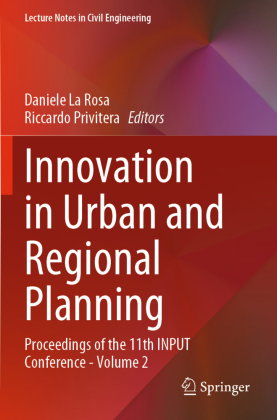
This book is the second Volume of the INPUT2020 Conference Proceedings on 'Innovation in Urban and Regional Planning'. The 11th International Conference INPUT was held at the University of Catania (Italy) on September 8-10th 2021 and allowed gathering international scholars in the fields of planning, civil engineering and architecture, ecology and social science, to strengthen the knowledge on nature-based solutions and to enhance the implementation and replication of these solutions in different contexts. INPUT2020 Conference stressed the basic idea that using components that mimic natural processes in the built environment can generate a wide number of benefits in cities, and produced more equal, safe and livable urban environment. The book provides additional reflections and proposals on empirical frameworks for nature-based solutions. Computational tools, technologies, data and hybrid models are explored for providing innovative spatial planning modeling methodologies. Furthermore, prospective roles of nature-based solutions in planning science and practice are investigated in the light of peripheralisation risks, rural landscapes and innovation in cultural heritage.