






Diese Website verwendet Cookies und ähnliche Technologien. Dabei handelt es sich um kleine Textdateien, die auf eurem Computer gespeichert und ausgelesen werden. Indem ihr auf "Alles akzeptieren" klickt, stimmt ihr der Verarbeitung von Daten, der Erstellung und Verarbeitung von individuellen Nutzungsprofilen über Websites und über Partner und Geräte hinweg sowie der Übermittlung eurer Daten an Drittanbieter zu, die eure Daten teilweise in Ländern außerhalb der Europäischen Union verarbeiten (GDPR Art. 49). Einzelheiten hierzu findet ihr in den Datenschutzhinweisen. Die Daten werden für Analysen und für eigene Zwecke Dritter verwendet. Weitere Informationen, auch über die Datenverarbeitung durch Drittanbieter und die Möglichkeit des Widerrufs, findet ihr in den Einstellungen und in unseren Datenschutzhinweisen. Hier könnt ihr mit den notwendigen Tools fortfahren.
- Verlag: Springer, Berlin
- Autor: Bryan E. Penprase
- Artikel-Nr.: KNV96324159
- ISBN: 9783031278891
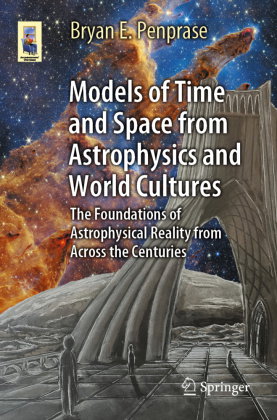
Models of Time and Space from Astrophysics and World Cultures explores how our conceptions of time, space, and the physical universe have evolved across cultures throughout the centuries. Developed with a humanistic approach, this book blends historical sources, biographical profiles of exceptional scientists, and the latest discoveries in both astrophysics and particle physics. This rich read describes the incredible insights and ultimate limits of our knowledge, the physical universe, and how ideas old and new have converged, across the world, to build our current understanding of reality. From the Large Hadron Collider to the James Webb Space Telescope, we have mapped the universe from the smallest to largest scales; allowing us to gain fundamental knowledge that has transformed our understanding of the universe.
The chapters herein will teach you about dark matter and dark energy, gravitational waves and other complex parts of the cosmos. Along the way, you will learn a thing or two about quantum mechanics, parallel universes, and the ultimate boundaries of the observable universe. This book cultivates insight from a variety of cultural traditions, including perspectives from both modern and ancient cultures, in order to show how our modern conceptions of space and time have arisen from the ongoing explorations within ancient world civilizations.
It is a valuable, intriguing and insightful volume for those interested in the fields of historical astronomy and cultural astronomy, as well as for anyone interested in learning about the latest finds from the field of physics and astrophysics.