






Diese Website verwendet Cookies und ähnliche Technologien. Dabei handelt es sich um kleine Textdateien, die auf eurem Computer gespeichert und ausgelesen werden. Indem ihr auf "Alles akzeptieren" klickt, stimmt ihr der Verarbeitung von Daten, der Erstellung und Verarbeitung von individuellen Nutzungsprofilen über Websites und über Partner und Geräte hinweg sowie der Übermittlung eurer Daten an Drittanbieter zu, die eure Daten teilweise in Ländern außerhalb der Europäischen Union verarbeiten (GDPR Art. 49). Einzelheiten hierzu findet ihr in den Datenschutzhinweisen. Die Daten werden für Analysen und für eigene Zwecke Dritter verwendet. Weitere Informationen, auch über die Datenverarbeitung durch Drittanbieter und die Möglichkeit des Widerrufs, findet ihr in den Einstellungen und in unseren Datenschutzhinweisen. Hier könnt ihr mit den notwendigen Tools fortfahren.
- Verlag: Springer, Berlin
- Autor: Alina Galvão Spinillo
- Artikel-Nr.: KNV96367526
- ISBN: 9783031292859
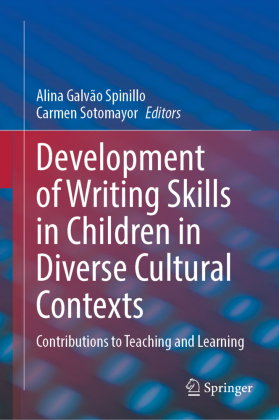
This book brings together multiple theoretical perspectives and disciplinary approaches to study the acquisition and development of written language by children as well as the implications for teaching and learning of writing practices in a variety of languages and cultural contexts. Chapters in this contributed volume present both theoretical contributions and results of research carried out with students and teachers from 11 countries (Belgium, Brazil, Chile, Israel, Italy, Mexico, the Netherlands, Portugal, Spain, UK and USA) who speak seven different languages: Portuguese, Spanish, English, Italian, French, Dutch and Hebrew. By bringing together research developed in diverse cultural contexts it enriches the debates in the interdisciplinary field of writing studies by analyzing a wide range of topics at the interface between research and educational implications for the teaching and learning of writing by children.
The book consists of five parts, each one addressing a specific set of topics. Part I presents studies on topics related to written language representation systems (phonological and morphological awareness) and on the relationship between grammar and the quality of texts of different genres. Part II includes studies related to compositional processes of writing texts, and the factors involved in these processes. Part III focuses on the difficulties faced by students during the acquisition and development of writing. Part IV is dedicated to chapters that discuss and compare writing practices in different social environments. Finally, chapters in part V deal with teaching and learning of writing in the school setting.
Development of Writing Skills in Children in Diverse Cultural Contexts: Contributions to Teaching and Learning will be of interest to researchers and students in the fields of psychology, education and linguistics, as well as to other social scientists in the broader interdisciplinary field of writingstudies.