






Diese Website verwendet Cookies und ähnliche Technologien. Dabei handelt es sich um kleine Textdateien, die auf eurem Computer gespeichert und ausgelesen werden. Indem ihr auf "Alles akzeptieren" klickt, stimmt ihr der Verarbeitung von Daten, der Erstellung und Verarbeitung von individuellen Nutzungsprofilen über Websites und über Partner und Geräte hinweg sowie der Übermittlung eurer Daten an Drittanbieter zu, die eure Daten teilweise in Ländern außerhalb der Europäischen Union verarbeiten (GDPR Art. 49). Einzelheiten hierzu findet ihr in den Datenschutzhinweisen. Die Daten werden für Analysen und für eigene Zwecke Dritter verwendet. Weitere Informationen, auch über die Datenverarbeitung durch Drittanbieter und die Möglichkeit des Widerrufs, findet ihr in den Einstellungen und in unseren Datenschutzhinweisen. Hier könnt ihr mit den notwendigen Tools fortfahren.
- Verlag: Elsevier Science & Technology
- Autor: Austin Hughes
- Artikel-Nr.: KNV96376622
- ISBN: 9780081026151
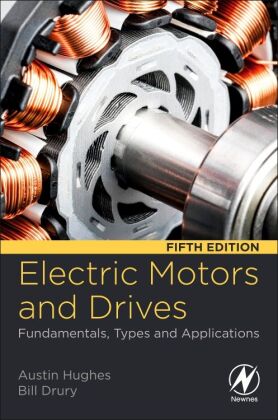
Electric Motors and Drives: Fundamentals, Types and Applications, Fifth Edition is intended primarily for non-specialist users or students of electric motors and drives, but many researchers and specialist industrialists have also acknowledged its value in providing a clear understanding of the fundamentals. It bridges the gap between specialist textbooks (too analytical for the average user) and handbooks (full of detail but with little insight) providing an understanding of how each motor and drive system works.
The fifth edition has been completely revised, updated and expanded. All of the most important types of motor and drive are covered, including d.c., induction, synchronous (including synchronous reluctance and salient Permanent Magnet), switched reluctance, and stepping. There has been significant innovation in this area since the fourth edition, particularly in the automotive, aircraft and industrial sectors, with novel motor topologies emerging, including hybrid designs that combine permanent magnet and reluctance effects. We now include a physical basis for understanding and quantifying torque production in these machines, and this leads to simple pictures that illuminate the control conditions required to optimise torque. The key converter topologies have been brought together, and the treatment of inverter switching strategies expanded.
A new chapter is devoted to the treatment of Field Oriented control, reflecting its increasing importance for all a.c. motor drives. A unique physically-based approach is adopted which builds naturally on the understanding of motor behaviour developed earlier in the book: the largely non-mathematical treatment dispels much of the mystique surrounding what is often regarded as a difficult topic.