






Diese Website verwendet Cookies und ähnliche Technologien. Dabei handelt es sich um kleine Textdateien, die auf eurem Computer gespeichert und ausgelesen werden. Indem ihr auf "Alles akzeptieren" klickt, stimmt ihr der Verarbeitung von Daten, der Erstellung und Verarbeitung von individuellen Nutzungsprofilen über Websites und über Partner und Geräte hinweg sowie der Übermittlung eurer Daten an Drittanbieter zu, die eure Daten teilweise in Ländern außerhalb der Europäischen Union verarbeiten (GDPR Art. 49). Einzelheiten hierzu findet ihr in den Datenschutzhinweisen. Die Daten werden für Analysen und für eigene Zwecke Dritter verwendet. Weitere Informationen, auch über die Datenverarbeitung durch Drittanbieter und die Möglichkeit des Widerrufs, findet ihr in den Einstellungen und in unseren Datenschutzhinweisen. Hier könnt ihr mit den notwendigen Tools fortfahren.
- Verlag: Elsevier Science & Technology
- Autor: John G. Toffaletti
- Artikel-Nr.: KNV96381077
- ISBN: 9780323899710
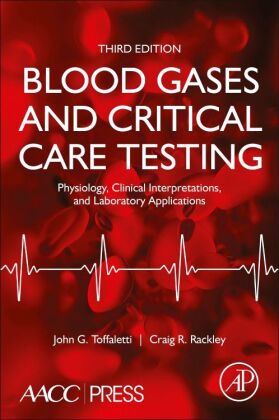
Blood gas tests are a group of tests that are widely used and essential for the evaluation and management of a patient's ventilation, oxygenation, and acid-base balance, often in emergent situations, and along with blood gases are other critical care analytes measured on blood: calcium, magnesium, phosphate, and lactate. Blood Gases and Critical Care Testing: Clinical Interpretations and Laboratory Applications, Third Edition, serves as your single most important reference for understanding blood gases and critical care testing and interpretation.
The third edition of this classic book is a complete revision and provides the fundamentals of blood gas (pH, pCO2, pO2) and other critical care tests (calcium, magnesium, phosphate, and lactate), including the history, the definitions, the physiology, and practical information on sample handling, quality control and reference intervals. Case examples with clear clinical interpretations of critical care tests have been included to all chapters.
This book will serve as a valuable and convenient resource for clinical laboratory scientists in understanding the physiology and clinical use of these critical care tests and for providing practical guidelines for successful routine testing and quality monitoring of these tests.