


Diese Website verwendet Cookies und ähnliche Technologien. Dabei handelt es sich um kleine Textdateien, die auf eurem Computer gespeichert und ausgelesen werden. Indem ihr auf "Alles akzeptieren" klickt, stimmt ihr der Verarbeitung von Daten, der Erstellung und Verarbeitung von individuellen Nutzungsprofilen über Websites und über Partner und Geräte hinweg sowie der Übermittlung eurer Daten an Drittanbieter zu, die eure Daten teilweise in Ländern außerhalb der Europäischen Union verarbeiten (GDPR Art. 49). Einzelheiten hierzu findet ihr in den Datenschutzhinweisen. Die Daten werden für Analysen und für eigene Zwecke Dritter verwendet. Weitere Informationen, auch über die Datenverarbeitung durch Drittanbieter und die Möglichkeit des Widerrufs, findet ihr in den Einstellungen und in unseren Datenschutzhinweisen. Hier könnt ihr mit den notwendigen Tools fortfahren.
- Verlag: Elsevier Science & Technology
- Autor: Bridget J.M. Stutchbury
- Artikel-Nr.: KNV96380770
- ISBN: 9780128238141
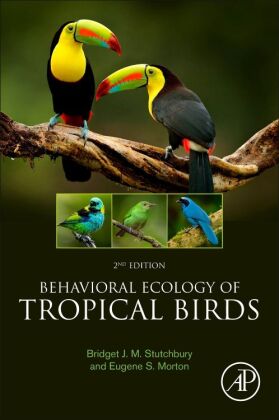
Behavioral Ecology of Tropical Birds, Second Edition provides the most updated and comprehensive review on the evolution of behavior in tropical landbirds. The book reviews gaps in our knowledge that were identified twenty years ago when the first edition was published, highlights recent discoveries that have filled those gaps, and identifies new areas in urgent need of study. It covers key topics, including timing of breeding, movement ecology, life history traits, slow vs. fast pace of life, mating systems, mate choice, territoriality, communication, biotic interactions, and conservation.
Written by international experts on the behavior of tropical birds, the book explores why the tropics is a unique natural laboratory to study the evolution of bird behavior and why temperate zone species are so different. A recent surge of studies on tropical birds has helped to reduce the temperate zone bias that arose because most avian model species in behavioral ecology were adapted to northern temperate climates. This is an important resource for researchers, ecologists and conservationists who want to understand the rich and complex evolutionary history of avian behavior.