






Diese Website verwendet Cookies und ähnliche Technologien. Dabei handelt es sich um kleine Textdateien, die auf eurem Computer gespeichert und ausgelesen werden. Indem ihr auf "Alles akzeptieren" klickt, stimmt ihr der Verarbeitung von Daten, der Erstellung und Verarbeitung von individuellen Nutzungsprofilen über Websites und über Partner und Geräte hinweg sowie der Übermittlung eurer Daten an Drittanbieter zu, die eure Daten teilweise in Ländern außerhalb der Europäischen Union verarbeiten (GDPR Art. 49). Einzelheiten hierzu findet ihr in den Datenschutzhinweisen. Die Daten werden für Analysen und für eigene Zwecke Dritter verwendet. Weitere Informationen, auch über die Datenverarbeitung durch Drittanbieter und die Möglichkeit des Widerrufs, findet ihr in den Einstellungen und in unseren Datenschutzhinweisen. Hier könnt ihr mit den notwendigen Tools fortfahren.
- Verlag: Springer, Berlin
- Autor: Regina Polak
- Artikel-Nr.: KNV96409833
- ISBN: 9783031313660
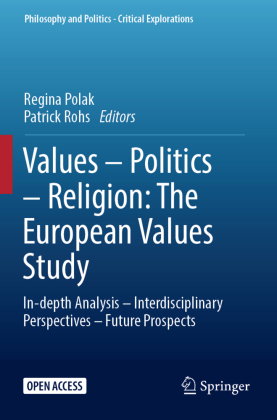
This open access book analyses the international data of the European Values Study (EVS 1990 - 2017), with a focus on the impact of religious on political values from empirical as well as theoretical perspectives, i.e. sociology, political and cultural studies, philosophy, ethics, theology and the law. It interprets results from interdisciplinary perspectives, including the viewpoints of social ethics, sociology and cultural studies, law and practical theology. In the political and public as well as media debates of the European Union, the recourse to (above all "European" and also "Christian") values has played a central and controversial role in the field of politics and religion for several decades. This collection is a contribution to a qualified discourse on values in Europe by providing empirical, hermeneutical and ethical criteria for a responsible use of the concept of values. In addition to a comparison of political value systems in Western and Eastern Europe and the possible role of religion in this context, the book also deals with topics such as, f.i., solidarity, economics and values, value formation, and law and values. Additionally, specific population groups such as the socio-culturally marginalized strata are examined more closely. Besides current scientific analyses and interpretations of interest to researchers from various disciplines, this book also offers valuable impulses and suggestions for various multipliers in political, civil society and religious organisations, as well as a sound overview for graduate students.