






Diese Website verwendet Cookies und ähnliche Technologien. Dabei handelt es sich um kleine Textdateien, die auf eurem Computer gespeichert und ausgelesen werden. Indem ihr auf "Alles akzeptieren" klickt, stimmt ihr der Verarbeitung von Daten, der Erstellung und Verarbeitung von individuellen Nutzungsprofilen über Websites und über Partner und Geräte hinweg sowie der Übermittlung eurer Daten an Drittanbieter zu, die eure Daten teilweise in Ländern außerhalb der Europäischen Union verarbeiten (GDPR Art. 49). Einzelheiten hierzu findet ihr in den Datenschutzhinweisen. Die Daten werden für Analysen und für eigene Zwecke Dritter verwendet. Weitere Informationen, auch über die Datenverarbeitung durch Drittanbieter und die Möglichkeit des Widerrufs, findet ihr in den Einstellungen und in unseren Datenschutzhinweisen. Hier könnt ihr mit den notwendigen Tools fortfahren.
- Verlag: Taylor & Francis
- Autor: Paul J. Thibault
- Artikel-Nr.: KNV96361279
- ISBN: 9780367611903
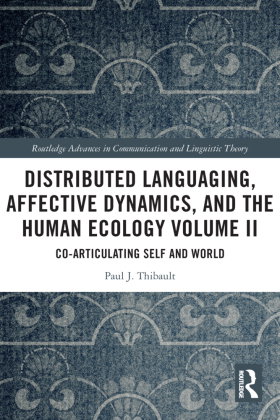
Language plays a central role in human life. However, the term "language" as defined in the language sciences of the 20th century and the traditions these have drawn on, have arguably limited our thinking about what language is and does. The two inter-linked volumes of Thibault's study articulate crucially important aspects of an emerging new perspective shift on language-the Distributed Language view-that is now receiving more and more attention internationally. Rejecting the classical view that the fundamental architecture of language can be localised as a number of inter-related levels of formal linguistic organisation that function as the coded inputs and outputs to each other, the distributed language view argues that languaging behaviour is a bio-cultural organiation of process that is embodied, multimodal, and integrated across multiple space-time scales.
Thibault argues that we need to think of human languaging as the distinctively human mode of our becoming and being selves in the extended human ecology and the kinds of experiencing that this makes possible. Paradoxically, this also means thinking about language in non-linguistic ways that break the grip of the conventional meta-languages for thinking about human languaging. Thibault's book grounds languaging in process theory: languaging and the forms of experience it actualises is always an event, not a thing that we "use". In taking a distinctively interdisciplinary approach, the book relates dialogical theories of human sense-making to the distributed view of human cognition, to recent thinking about distributed language, to ecological psychology, and to languaging as inter-individual affective dynamics grounded in the subjective lives of selves. In taking this approach, the book considers the coordination of selves in social encounters, the emergent forms of self-reflexivity that characterise these encounters, and the implications for how we think of and live our human sociality, not as something that is mediated by over-arching codes and systems, but as emerging from the endogenous subjectivities of selves when they seek to coordinate with other selves and with the situations, artefacts, social institutions, and technologies that populate the extended human ecology.
The two volumes aim to bring our understanding of human languaging closer to human embodiment, experience, and feeling while also showing how languaging enables humans to transcend local circumstances and thus to dialogue with cultural tradition. Volume I focuses on the shorter timescales of bodily dynamics in languaging activity. Volume II integrates the shorter timescales of body dynamics to the longer cultural-historical timescales of the linguistic and cultural norms and patterns to which bodily dynamics are integrated.