






Diese Website verwendet Cookies und ähnliche Technologien. Dabei handelt es sich um kleine Textdateien, die auf eurem Computer gespeichert und ausgelesen werden. Indem ihr auf "Alles akzeptieren" klickt, stimmt ihr der Verarbeitung von Daten, der Erstellung und Verarbeitung von individuellen Nutzungsprofilen über Websites und über Partner und Geräte hinweg sowie der Übermittlung eurer Daten an Drittanbieter zu, die eure Daten teilweise in Ländern außerhalb der Europäischen Union verarbeiten (GDPR Art. 49). Einzelheiten hierzu findet ihr in den Datenschutzhinweisen. Die Daten werden für Analysen und für eigene Zwecke Dritter verwendet. Weitere Informationen, auch über die Datenverarbeitung durch Drittanbieter und die Möglichkeit des Widerrufs, findet ihr in den Einstellungen und in unseren Datenschutzhinweisen. Hier könnt ihr mit den notwendigen Tools fortfahren.
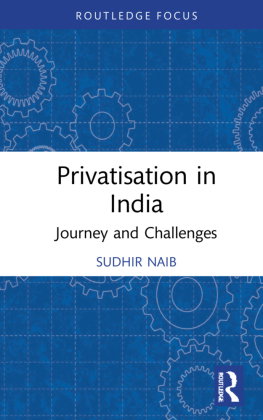
- Verlag: Taylor & Francis
- Autor: Sudhir Naib
- Artikel-Nr.: KNV96363154
- ISBN: 9781032201016
This book is a comprehensive work which incisively analyses, from a theoretically informed perspective, crucial aspects of India's journey from partial divestiture to privatisation, accompanied by case studies of enterprises being privatised in FY 2022.
Naib begins with the economic role of the state followed by theoretical and empirical evidence on the state versus private ownership in the first two chapters. Next, an overview of public sector in India including the New Public Sector Enterprise Policy for Atmanirbhar Bharat-2021 is discussed, before a broader examination of the global experience with privatisation is done. Naib then goes on to explore India's journey from partial divestiture to privatisation from 1991 to 2021 in four time slots based on the political party in power. The book also looks at big ticket privatisation and asset monetisation proposed in FY 2022. Many criticised the design of National Monetisation Plan as it may lead to concentration of wealth, increasing inequalities, asset stripping, and consumers paying higher charges. The book closes by presenting six instances of big-ticket privatisations ranging from airlines, airports, banks, insurance, as well as industries such as petroleum and telecoms.
The book's timely data and analysis of key developments will interest researchers in the fields of divestiture and privatisation in India.