






Diese Website verwendet Cookies und ähnliche Technologien. Dabei handelt es sich um kleine Textdateien, die auf eurem Computer gespeichert und ausgelesen werden. Indem ihr auf "Alles akzeptieren" klickt, stimmt ihr der Verarbeitung von Daten, der Erstellung und Verarbeitung von individuellen Nutzungsprofilen über Websites und über Partner und Geräte hinweg sowie der Übermittlung eurer Daten an Drittanbieter zu, die eure Daten teilweise in Ländern außerhalb der Europäischen Union verarbeiten (GDPR Art. 49). Einzelheiten hierzu findet ihr in den Datenschutzhinweisen. Die Daten werden für Analysen und für eigene Zwecke Dritter verwendet. Weitere Informationen, auch über die Datenverarbeitung durch Drittanbieter und die Möglichkeit des Widerrufs, findet ihr in den Einstellungen und in unseren Datenschutzhinweisen. Hier könnt ihr mit den notwendigen Tools fortfahren.
- Verlag: Taylor & Francis
- Autor: Prabhanjan Narayanachar Tattar
- Artikel-Nr.: KNV96363417
- ISBN: 9780367030377
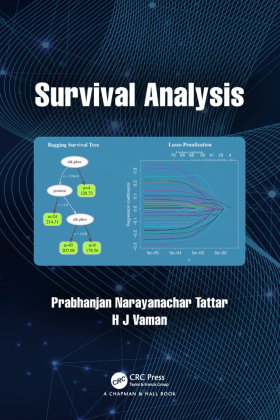
Survival analysis generally deals with analysis of data arising from clinical trials. Censoring, truncation, and missing data create analytical challenges and the statistical methods and inference require novel and different approaches for analysis. Statistical properties, essentially asymptotic ones, of the estimators and tests are aptly handled in the counting process framework which is drawn from the larger arm of stochastic calculus. With explosion of data generation during the past two decades, survival data has also enlarged assuming a gigantic size. Most statistical methods developed before the millennium were based on a linear approach even in the face of complex nature of survival data. Nonparametric nonlinear methods are best envisaged in the Machine Learning school. This book attempts to cover all these aspects in a concise way.
Survival Analysis offers an integrated blend of statistical methods and machine learning useful in analysis of survival data. The purpose of the offering is to give an exposure to the machine learning trends for lifetime data analysis.
Features:
- Classical survival analysis techniques for estimating statistical functional and hypotheses testing
- Regression methods covering the popular Cox relative risk regression model, Aalen's additive hazards model, etc.
- Information criteria to facilitate model selection including Akaike, Bayes, and Focused
- Penalized methods
- Survival trees and ensemble techniques of bagging, boosting, and random survival forests
- A brief exposure of neural networks for survival data
- R program illustration throughout the book