






Diese Website verwendet Cookies und ähnliche Technologien. Dabei handelt es sich um kleine Textdateien, die auf eurem Computer gespeichert und ausgelesen werden. Indem ihr auf "Alles akzeptieren" klickt, stimmt ihr der Verarbeitung von Daten, der Erstellung und Verarbeitung von individuellen Nutzungsprofilen über Websites und über Partner und Geräte hinweg sowie der Übermittlung eurer Daten an Drittanbieter zu, die eure Daten teilweise in Ländern außerhalb der Europäischen Union verarbeiten (GDPR Art. 49). Einzelheiten hierzu findet ihr in den Datenschutzhinweisen. Die Daten werden für Analysen und für eigene Zwecke Dritter verwendet. Weitere Informationen, auch über die Datenverarbeitung durch Drittanbieter und die Möglichkeit des Widerrufs, findet ihr in den Einstellungen und in unseren Datenschutzhinweisen. Hier könnt ihr mit den notwendigen Tools fortfahren.
- Verlag: Taylor & Francis
- Autor: André Torre
- Artikel-Nr.: KNV96363867
- ISBN: 9780367493462
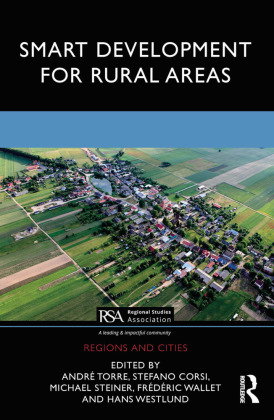
This thought-provoking book questions the framework of the Horizon 2020 strategy and the policies of smart development. It aims to answer the following question: Is there any possibility for a policy of smart development and smart specialization in rural and peri-urban areas? Based on detailed analytical studies, empirical and econometric methods, as well as various European case studies, several conclusions are drawn.
Smart development policies are well adapted to the developed or intermediate regions containing at the same time rural and urban areas, but do not really function for the more rural or more peripheral regions. The development policies of rural areas must be adapted to their particular characteristics, to the structure of their economies (agriculture, small firms), as well as in their diversity (distant regions, intermediate regions, rural areas near the urban areas). It appears interesting to exploit natural and cultural amenities, to develop the multifunctional character of the agriculture, to promote territorial innovation under all its forms, to favor the synergies between the various uses of land and space, and to develop the knowledge on the ecological, socioeconomic processes, as well as on the mechanisms of territorial governance.
These results are very important because they question the validity of the H2020 policy and the smart development and smart specialization policies and their applicability to the whole European area, and not only for the most urban and rich areas. It will be valuable reading for students, researchers and policy-makers in regional development, rural studies, spatial planning and economic geography.