






Diese Website verwendet Cookies und ähnliche Technologien. Dabei handelt es sich um kleine Textdateien, die auf eurem Computer gespeichert und ausgelesen werden. Indem ihr auf "Alles akzeptieren" klickt, stimmt ihr der Verarbeitung von Daten, der Erstellung und Verarbeitung von individuellen Nutzungsprofilen über Websites und über Partner und Geräte hinweg sowie der Übermittlung eurer Daten an Drittanbieter zu, die eure Daten teilweise in Ländern außerhalb der Europäischen Union verarbeiten (GDPR Art. 49). Einzelheiten hierzu findet ihr in den Datenschutzhinweisen. Die Daten werden für Analysen und für eigene Zwecke Dritter verwendet. Weitere Informationen, auch über die Datenverarbeitung durch Drittanbieter und die Möglichkeit des Widerrufs, findet ihr in den Einstellungen und in unseren Datenschutzhinweisen. Hier könnt ihr mit den notwendigen Tools fortfahren.
- Verlag: Taylor & Francis
- Autor: Sarah Dillon
- Artikel-Nr.: KNV96360039
- ISBN: 9780367406738
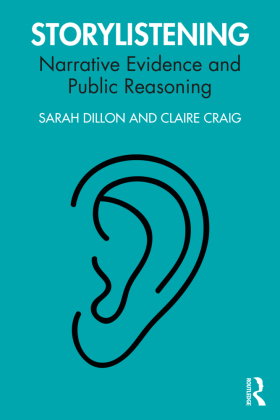
Storylistening makes the case for the urgent need to take stories seriously in order to improve public reasoning. Dillon and Craig provide a theory and practice for gathering narrative evidence that will complement and strengthen, not distort, other forms of evidence, including that from science.
Focusing on the cognitive and the collective, Dillon and Craig show how stories offer alternative points of view, create and cohere collective identities, function as narrative models, and play a crucial role in anticipation. They explore these four functions in areas of public reasoning where decisions are strongly influenced by contentious knowledge and powerful imaginings: climate change, artificial intelligence, the economy, and nuclear weapons and power. Vivid performative readings of stories from The Ballad of Tam-Lin to The Terminator demonstrate the insights that storylistening can bring and the ways it might be practised.
The book provokes a reimagining of what a public humanities might look like, and shows how the structures and practices of public reasoning can evolve to better incorporate narrative evidence. Storylistening aims to create the conditions in which the important task of listening to stories is possible, expected, and becomes endemic.
Taking the reader through complex ideas from different disciplines in ways that do not require any prior knowledge, this book is an essential read for policymakers, political scientists, students of literary studies, and anyone interested in the public humanities and the value, importance, and operation of narratives.