






Diese Website verwendet Cookies und ähnliche Technologien. Dabei handelt es sich um kleine Textdateien, die auf eurem Computer gespeichert und ausgelesen werden. Indem ihr auf "Alles akzeptieren" klickt, stimmt ihr der Verarbeitung von Daten, der Erstellung und Verarbeitung von individuellen Nutzungsprofilen über Websites und über Partner und Geräte hinweg sowie der Übermittlung eurer Daten an Drittanbieter zu, die eure Daten teilweise in Ländern außerhalb der Europäischen Union verarbeiten (GDPR Art. 49). Einzelheiten hierzu findet ihr in den Datenschutzhinweisen. Die Daten werden für Analysen und für eigene Zwecke Dritter verwendet. Weitere Informationen, auch über die Datenverarbeitung durch Drittanbieter und die Möglichkeit des Widerrufs, findet ihr in den Einstellungen und in unseren Datenschutzhinweisen. Hier könnt ihr mit den notwendigen Tools fortfahren.
- Verlag: Taylor & Francis
- Autor: Andreas Exner
- Artikel-Nr.: KNV96363927
- ISBN: 9780367693060
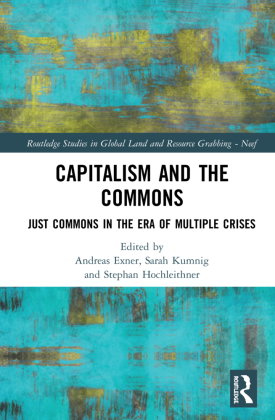
Capitalism and the Commons focuses on the political and social perspectives that commons offer, how they are appropriated or suppressed by capital and state, and how social initiatives and movements contest these dynamics or build their struggles on commoning.
The volume comprises theoretical and empirical approaches that engage with three main themes: conceptualizing the commons, analyzing practices of commoning, and exploring commons politics. In their contributions, the authors focus on the development of anti-capitalist commons and explore the issue of practice and politics through case studies from Colombia, the Democratic Republic of Congo, South Africa, and Africa more broadly, Austria, Germany and South Korea, ranging from peri-urban and rural agriculture to urban commons and how they manifest in the Global South as well as in the Global North. The book engages with different discourses on the commons in regard to their relevance for social change and thereby reinvigorates the political meaning of the commons. It provides an original and important approach to the topic in terms of conceptualization, detailing diverse empirical realities, and analyzing potential perspectives. In so doing, the book transcends narrow disciplinary boundaries and expands the focus to the global.
Providing a fresh perspective on the commons as a decisive component of alternatives, this title will be relevant to scholars and students of resource management, social movements, and sustainable development more broadly.