






Diese Website verwendet Cookies und ähnliche Technologien. Dabei handelt es sich um kleine Textdateien, die auf eurem Computer gespeichert und ausgelesen werden. Indem ihr auf "Alles akzeptieren" klickt, stimmt ihr der Verarbeitung von Daten, der Erstellung und Verarbeitung von individuellen Nutzungsprofilen über Websites und über Partner und Geräte hinweg sowie der Übermittlung eurer Daten an Drittanbieter zu, die eure Daten teilweise in Ländern außerhalb der Europäischen Union verarbeiten (GDPR Art. 49). Einzelheiten hierzu findet ihr in den Datenschutzhinweisen. Die Daten werden für Analysen und für eigene Zwecke Dritter verwendet. Weitere Informationen, auch über die Datenverarbeitung durch Drittanbieter und die Möglichkeit des Widerrufs, findet ihr in den Einstellungen und in unseren Datenschutzhinweisen. Hier könnt ihr mit den notwendigen Tools fortfahren.
- Verlag: Taylor & Francis
- Autor: Paulo Henrique Martins
- Artikel-Nr.: KNV96360124
- ISBN: 9781032118857
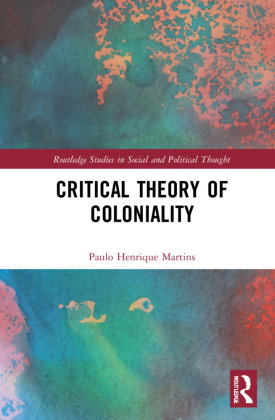
This book reveals how the critique of the domination of capitalism inaugurated by the Frankfurt School becomes pluriversal, motivating the historical Critical Theory of Coloniality (CTC) dialogue between the Global South and the Global North.
CTC expresses the emergence and historical actuality of a set of intellectual fields aimed at denouncing domination and promoting emancipatory ideas at the borders of colonial capitalism. The book argues that the actuality of the CTC relies on the importance of valuing theoretical and methodological pluralism in the context of the necessary redefinition of the directions of global society. It reveals a plural reflection of scientific, moral, and aesthetic character in different areas of former planetary colonisation such as Asia, Africa, and America but also on the borders of Europe.
This book is aimed at researchers and students in the social sciences as well as in interdisciplinary studies. It is attractive to those who are interested in the plural development of theoretical criticism outside the European universe and who seek to understand how capitalist power has metamorphosed with planetary coloniality. Considering this book implies important reflections on topics such as development, modernity, tradition, imperialism, dependency, and democracy, it is interesting to specialists in development issues, international relations, and policymakers.