






Diese Website verwendet Cookies und ähnliche Technologien. Dabei handelt es sich um kleine Textdateien, die auf eurem Computer gespeichert und ausgelesen werden. Indem ihr auf "Alles akzeptieren" klickt, stimmt ihr der Verarbeitung von Daten, der Erstellung und Verarbeitung von individuellen Nutzungsprofilen über Websites und über Partner und Geräte hinweg sowie der Übermittlung eurer Daten an Drittanbieter zu, die eure Daten teilweise in Ländern außerhalb der Europäischen Union verarbeiten (GDPR Art. 49). Einzelheiten hierzu findet ihr in den Datenschutzhinweisen. Die Daten werden für Analysen und für eigene Zwecke Dritter verwendet. Weitere Informationen, auch über die Datenverarbeitung durch Drittanbieter und die Möglichkeit des Widerrufs, findet ihr in den Einstellungen und in unseren Datenschutzhinweisen. Hier könnt ihr mit den notwendigen Tools fortfahren.
- Verlag: Taylor & Francis
- Autor: Sara Amin
- Artikel-Nr.: KNV96364034
- ISBN: 9781032336930
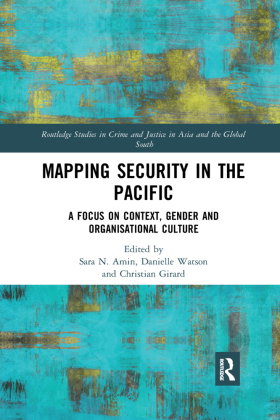
This book examines questions about the changing nature of security and insecurity in Pacific Island Countries (PICs). Previous discussions of security in the Pacific region have been largely determined by the geopolitical interests of the Global North. This volume instead attempts to centre PICs' security interests by focussing on the role of organisational culture, power dynamics and gender in (in)security processes and outcomes.
Mapping Security in the Pacific underscores the multidimensional nature of security, its relationship to local, international, organisational and cultural dynamics, the resistances engendered through various forms of insecurities, and innovative efforts to negotiate gender, context and organisational culture in reducing insecurity and enhancing justice. Covering the Pacific region widely, the volume brings forth context-specific analyses at micro-, meso- and macro-levels, allowing us to examine the interconnections between security, crime and justice, and point to the issues raised for crime and justice studies by environmental insecurity. In doing so, it opens up opportunities to rethink scholarly and policy frames related to security/insecurity about the Pacific.
Written in a clear and direct style, this book will appeal to students and scholars in criminology, sociology, cultural studies, social theory and those interested in learning about the Pacific region and different aspects of security.