






Diese Website verwendet Cookies und ähnliche Technologien. Dabei handelt es sich um kleine Textdateien, die auf eurem Computer gespeichert und ausgelesen werden. Indem ihr auf "Alles akzeptieren" klickt, stimmt ihr der Verarbeitung von Daten, der Erstellung und Verarbeitung von individuellen Nutzungsprofilen über Websites und über Partner und Geräte hinweg sowie der Übermittlung eurer Daten an Drittanbieter zu, die eure Daten teilweise in Ländern außerhalb der Europäischen Union verarbeiten (GDPR Art. 49). Einzelheiten hierzu findet ihr in den Datenschutzhinweisen. Die Daten werden für Analysen und für eigene Zwecke Dritter verwendet. Weitere Informationen, auch über die Datenverarbeitung durch Drittanbieter und die Möglichkeit des Widerrufs, findet ihr in den Einstellungen und in unseren Datenschutzhinweisen. Hier könnt ihr mit den notwendigen Tools fortfahren.
- Verlag: Taylor & Francis
- Autor: Georg N. Schäfer
- Artikel-Nr.: KNV96364032
- ISBN: 9781032262192
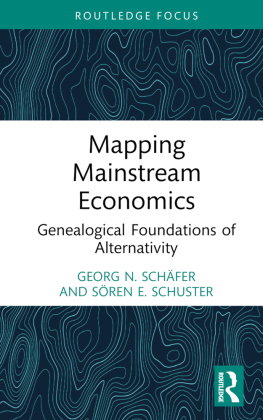
Mapping Mainstream Economics: Genealogical Foundations of Alternativity seeks to establish a definition of the mainstream economics, and by extension the alternatives to it, by adopting a genealogical approach: tracing the methodological development of the economic mainstream through its ancestry, which allows for a definition of the mainstream that is separate from politically charged categories or gridlocked academic arguments between received schools of thought.
The book follows the evolution of the economic mainstream through four major transformations of the discipline: from political to analytical economics, debates around a logical empiricist economics, the consolidation of neoclassical economics, and the recent expansion of the mainstream. For each of these steps, the key point of departure is explored, illustrated through the work of leading authors at the time. Thus, the book draws on recent research from the history of economic thought and debates the crucial role of historic concepts of economics for alternativity in the field. To put the approach into practice, it examines the relation between today's mainstream economics and two of its alternatives: ecological economics and degrowth. Finally, the book reflects on recent exciting developments in the discourse on alternativity and sheds light on some distant relatives of today's mainstream. This book marks a significant contribution to the literature on the debates around the state and nature of mainstream, alternative, and heterodox economics.