






Diese Website verwendet Cookies und ähnliche Technologien. Dabei handelt es sich um kleine Textdateien, die auf eurem Computer gespeichert und ausgelesen werden. Indem ihr auf "Alles akzeptieren" klickt, stimmt ihr der Verarbeitung von Daten, der Erstellung und Verarbeitung von individuellen Nutzungsprofilen über Websites und über Partner und Geräte hinweg sowie der Übermittlung eurer Daten an Drittanbieter zu, die eure Daten teilweise in Ländern außerhalb der Europäischen Union verarbeiten (GDPR Art. 49). Einzelheiten hierzu findet ihr in den Datenschutzhinweisen. Die Daten werden für Analysen und für eigene Zwecke Dritter verwendet. Weitere Informationen, auch über die Datenverarbeitung durch Drittanbieter und die Möglichkeit des Widerrufs, findet ihr in den Einstellungen und in unseren Datenschutzhinweisen. Hier könnt ihr mit den notwendigen Tools fortfahren.
- Verlag: Taylor & Francis
- Autor: Federico Savini
- Artikel-Nr.: KNV96360244
- ISBN: 9780367751005
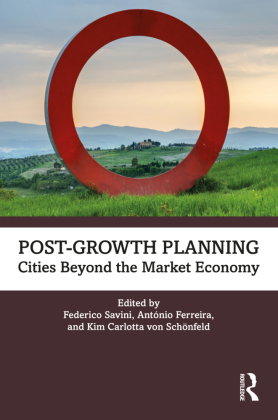
This book draws on a wide range of conceptual and empirical materials to identify and examine planning and policy approaches that move beyond the imperative of perpetual economic growth. It sketches out a path towards planning theories and practices that can break the cyclical process of urban expansion, crises, and recovery that negatively affect ecosystems and human lives.
To reduce the dramatic social and environmental impact of urbanization, this book offers both a critique of growth-led urban development and a prefiguration of ecologically regenerative and socially just ways of organizing cities and regions. It uncovers emerging possibilities for post-growth planning in the fields of collective housing, mobility, urban commoning, ecological land-use, urban-rural symbiosis, and alternative planning worldviews. It provides a toolkit of concepts and real-life examples for urban scholars, urbanists, activists, architects, and designers seeking to make cities prosper within planetary boundaries.
This book speaks to both experts and beginners in post-growth thinking. It concludes with a manifesto and glossary of key terms for urban scholars, students, and practitioners.