






Diese Website verwendet Cookies und ähnliche Technologien. Dabei handelt es sich um kleine Textdateien, die auf eurem Computer gespeichert und ausgelesen werden. Indem ihr auf "Alles akzeptieren" klickt, stimmt ihr der Verarbeitung von Daten, der Erstellung und Verarbeitung von individuellen Nutzungsprofilen über Websites und über Partner und Geräte hinweg sowie der Übermittlung eurer Daten an Drittanbieter zu, die eure Daten teilweise in Ländern außerhalb der Europäischen Union verarbeiten (GDPR Art. 49). Einzelheiten hierzu findet ihr in den Datenschutzhinweisen. Die Daten werden für Analysen und für eigene Zwecke Dritter verwendet. Weitere Informationen, auch über die Datenverarbeitung durch Drittanbieter und die Möglichkeit des Widerrufs, findet ihr in den Einstellungen und in unseren Datenschutzhinweisen. Hier könnt ihr mit den notwendigen Tools fortfahren.
- Verlag: Taylor & Francis
- Autor: Anneli Jefferson
- Artikel-Nr.: KNV96364428
- ISBN: 9780367421380
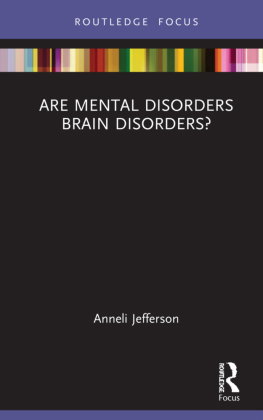
The question of whether mental disorders are disorders of the brain has led to a long-running and controversial dispute within psychiatry, psychology and philosophy of mind and psychology. While recent work in neuroscience frequently tries to identify underlying brain dysfunction in mental disorders, detractors argue that labelling mental disorders as brain disorders is reductive and can result in harmful social effects.
This book brings a much-needed philosophical perspective to bear on this important question. Anneli Jefferson argues that while there is widespread agreement on paradigmatic cases of brain disorder such as brain cancer, Parkinson's or Alzheimer's dementia, there is far less clarity on what the general, defining characteristics of brain disorders are. She identifies influential notions of brain disorder and shows why these are problematic. On her own, alternative, account, what counts as dysfunctional at the level of the brain frequently depends on what counts as dysfunctional at the psychological level. On this notion of brain disorder, she argues, many of the consequences people often associate with the brain disorder label do not follow. She also explores the important practical question of how to deal with the fact that many people do draw unlicensed inferences about treatment, personal responsibility or etiology from the information that a condition is a brain disorder or involves brain dysfunction.