






Diese Website verwendet Cookies und ähnliche Technologien. Dabei handelt es sich um kleine Textdateien, die auf eurem Computer gespeichert und ausgelesen werden. Indem ihr auf "Alles akzeptieren" klickt, stimmt ihr der Verarbeitung von Daten, der Erstellung und Verarbeitung von individuellen Nutzungsprofilen über Websites und über Partner und Geräte hinweg sowie der Übermittlung eurer Daten an Drittanbieter zu, die eure Daten teilweise in Ländern außerhalb der Europäischen Union verarbeiten (GDPR Art. 49). Einzelheiten hierzu findet ihr in den Datenschutzhinweisen. Die Daten werden für Analysen und für eigene Zwecke Dritter verwendet. Weitere Informationen, auch über die Datenverarbeitung durch Drittanbieter und die Möglichkeit des Widerrufs, findet ihr in den Einstellungen und in unseren Datenschutzhinweisen. Hier könnt ihr mit den notwendigen Tools fortfahren.
- Verlag: Taylor & Francis
- Autor: Penny A. Pasque
- Artikel-Nr.: KNV96364418
- ISBN: 9780367648626
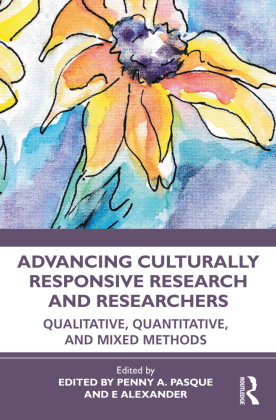
Advancing Culturally Responsive Research and Researchers: Qualitative, Quantitative, and Mixed Methods encourages readers to design and engage in methodologies and methods that place cultural relevancy at the center of inquiry. In doing so, it highlights the need to uplift voices and needs of people who have been historically marginalized in the environments that we both inhabit and engage in as part of knowledge construction.
The scholars whose work is featured in this volume take up research from different paradigmatic, ontological, epistemological, axiological, and methodological approaches - yet, with adherence to centering cultural responsiveness in all research decisions. Each chapter seeks to extend understandings of social inequities, methodologies, and/or methods - and to contribute to meaningful and evolving social change through innovative and cutting-edge research strategies. While doing this work, the authors illustrate and highlight the importance of researcher positions and reflexivity in supporting the expansion of culturally responsive approaches; they also do so while considering global sociopolitical conditions of this moment in time. The contributions to this volume were initially presented at the first biennial Advanced Methods Institute in 2021. The Institute was hosted by QualLab in The Ohio State University's College of Education and Human Ecology and shared this volume's thematic focus.
As a handbook, the volume can help faculty and advanced researchers with interest in doing culturally responsive projects to better understand frameworks, approaches, and considerations for doing so. It includes activities to support readers in developing said understandings.