






Diese Website verwendet Cookies und ähnliche Technologien. Dabei handelt es sich um kleine Textdateien, die auf eurem Computer gespeichert und ausgelesen werden. Indem ihr auf "Alles akzeptieren" klickt, stimmt ihr der Verarbeitung von Daten, der Erstellung und Verarbeitung von individuellen Nutzungsprofilen über Websites und über Partner und Geräte hinweg sowie der Übermittlung eurer Daten an Drittanbieter zu, die eure Daten teilweise in Ländern außerhalb der Europäischen Union verarbeiten (GDPR Art. 49). Einzelheiten hierzu findet ihr in den Datenschutzhinweisen. Die Daten werden für Analysen und für eigene Zwecke Dritter verwendet. Weitere Informationen, auch über die Datenverarbeitung durch Drittanbieter und die Möglichkeit des Widerrufs, findet ihr in den Einstellungen und in unseren Datenschutzhinweisen. Hier könnt ihr mit den notwendigen Tools fortfahren.
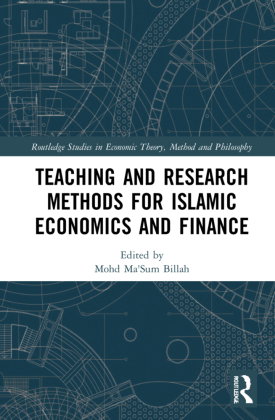
- Verlag: Taylor & Francis
- Autor: Mohd Ma'Sum Billah
- Artikel-Nr.: KNV96360839
- ISBN: 9781032180816
Methods and techniques adopted in teaching, training, learning, research, professional development, or capacity building are generally standardized across most traditional disciplines, particularly within developing countries. This is not the case, however, when it comes to the Islamic disciplines, and, in particular, in relation to the study of Islamic economics and finance, which is influenced by conventional standards and techniques. This is primarily due to the lack of availability of the requisite standards and mechanisms designed within the spirit of Maqsid al-Shari'ah.
This book offers a unique resource and a comprehensive overview of the contemporary methods and smart techniques available for teaching, learning, and researching Islamic eco-finance, and it presents solutions to the challenges in implementing them. Further, the book gives deep insight into the most appropriate methodologies that could be employed empirically to explore, model, analyze, and evaluate Islamic finance theories and models, respectively. It also gives recommendations for improving learning, teaching, and research outcomes in Islamic eco-finance. The book also addresses how, in this advanced technological era, smart tools like artificial intelligence, machine learning, big data, Zoom, and the internet of things can be adapted to help equip students, researchers, and scholars with smart skills.
The book will enable those studying Islamic economics and finance to grasp the appropriate tools for research and learning. Additionally, the Islamic economics and finance sector is growing at a significant rate and therefore requires the upskilling and capacity building of its human resources; thus, the book will also be highly beneficial for practitioners involved in the industry.