






Diese Website verwendet Cookies und ähnliche Technologien. Dabei handelt es sich um kleine Textdateien, die auf eurem Computer gespeichert und ausgelesen werden. Indem ihr auf "Alles akzeptieren" klickt, stimmt ihr der Verarbeitung von Daten, der Erstellung und Verarbeitung von individuellen Nutzungsprofilen über Websites und über Partner und Geräte hinweg sowie der Übermittlung eurer Daten an Drittanbieter zu, die eure Daten teilweise in Ländern außerhalb der Europäischen Union verarbeiten (GDPR Art. 49). Einzelheiten hierzu findet ihr in den Datenschutzhinweisen. Die Daten werden für Analysen und für eigene Zwecke Dritter verwendet. Weitere Informationen, auch über die Datenverarbeitung durch Drittanbieter und die Möglichkeit des Widerrufs, findet ihr in den Einstellungen und in unseren Datenschutzhinweisen. Hier könnt ihr mit den notwendigen Tools fortfahren.
- Verlag: Taylor & Francis
- Autor: Anthony Spires
- Artikel-Nr.: KNV96360841
- ISBN: 9781032188850
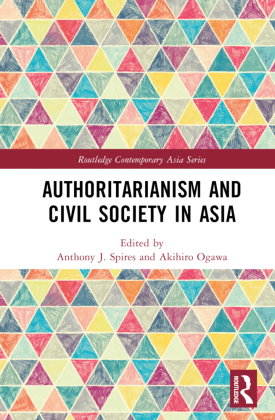
This book represents a pioneering interdisciplinary effort to analyze Asian civil society under authoritarianism, a regime type that is re-appearing or deepening after several decades of increased political liberalization.
By organizing its approach into four main themes, this volume succinctly reveals the challenges facing civil society in authoritarian regimes, including: actions under political repression, transitions to democracy, uncivil society, political capture and legal control. It features in-depth analyses of a variety of Asian nations, from 'hard' authoritarian regimes, like China, to 'electoral' authoritarian regimes, like Cambodia, whilst also addressing countries experiencing democratic regression, such as the Philippines. By highlighting concrete responses and initiatives taken by civil society under authoritarianism, it advances the intellectual mandate of redefining Asia as a dynamic and interconnected formation and, moreover, as a space for the production of new theoretical insight.
Contributing to our understanding of the tensions, dynamics, and potentialities that animate state-society relations in authoritarian regimes, this will be essential reading for students and scholars of civil society, authoritarianism, and Asian politics more generally.