






Diese Website verwendet Cookies und ähnliche Technologien. Dabei handelt es sich um kleine Textdateien, die auf eurem Computer gespeichert und ausgelesen werden. Indem ihr auf "Alles akzeptieren" klickt, stimmt ihr der Verarbeitung von Daten, der Erstellung und Verarbeitung von individuellen Nutzungsprofilen über Websites und über Partner und Geräte hinweg sowie der Übermittlung eurer Daten an Drittanbieter zu, die eure Daten teilweise in Ländern außerhalb der Europäischen Union verarbeiten (GDPR Art. 49). Einzelheiten hierzu findet ihr in den Datenschutzhinweisen. Die Daten werden für Analysen und für eigene Zwecke Dritter verwendet. Weitere Informationen, auch über die Datenverarbeitung durch Drittanbieter und die Möglichkeit des Widerrufs, findet ihr in den Einstellungen und in unseren Datenschutzhinweisen. Hier könnt ihr mit den notwendigen Tools fortfahren.
- Verlag: Taylor & Francis
- Autor: Luca Mora
- Artikel-Nr.: KNV96360824
- ISBN: 9781032071633
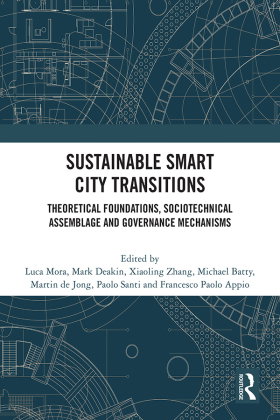
This book enhances the reader's understanding of the theoretical foundations, sociotechnical assemblage, and governance mechanisms of sustainable smart city transitions.
Drawing on empirical evidence stemming from existing smart city research, the book begins by advancing a theory of sustainable smart city transitions, which forms bridges between smart city development studies and some of the key assumptions underpinning transition management and system innovation research, human geography, spatial planning, and critical urban scholarship. This interdisciplinary theoretical formulation details how smart city transitions unfold and how they should be conceptualized and enacted in order to be assembled as sustainable developments. The proposed theory of sustainable smart city transitions is then enriched by the findings of investigations into the planning and implementation of smart city transition strategies and projects.
Focusing on different empirical settings, change dimensions, and analytical elements, the attention moves from the sociotechnical requirements of citywide transition pathways to the development of sector-specific smart city projects and technological innovations, in particular in the fields of urban mobility and urban governance.
This book represents a relevant reference work for academic and practitioner audiences, policy makers, and representative of smart city industries.
The chapters in this book were originally published as a special issue of the Journal of Urban Technology.