






Diese Website verwendet Cookies und ähnliche Technologien. Dabei handelt es sich um kleine Textdateien, die auf eurem Computer gespeichert und ausgelesen werden. Indem ihr auf "Alles akzeptieren" klickt, stimmt ihr der Verarbeitung von Daten, der Erstellung und Verarbeitung von individuellen Nutzungsprofilen über Websites und über Partner und Geräte hinweg sowie der Übermittlung eurer Daten an Drittanbieter zu, die eure Daten teilweise in Ländern außerhalb der Europäischen Union verarbeiten (GDPR Art. 49). Einzelheiten hierzu findet ihr in den Datenschutzhinweisen. Die Daten werden für Analysen und für eigene Zwecke Dritter verwendet. Weitere Informationen, auch über die Datenverarbeitung durch Drittanbieter und die Möglichkeit des Widerrufs, findet ihr in den Einstellungen und in unseren Datenschutzhinweisen. Hier könnt ihr mit den notwendigen Tools fortfahren.
- Verlag: Taylor & Francis
- Autor: Thandeka K. Chapman
- Artikel-Nr.: KNV96360873
- ISBN: 9780367370299
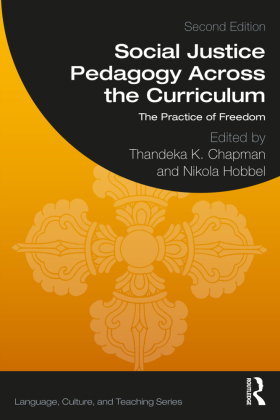
How can we continue to support educators who wish to design and facilitate social justice classrooms? What knowledge and tools do pre- and in-service educators need to teach about (in)equity, (in)justice, resilience, and agency across the curriculum in K-12 classrooms?
The new edition of this compelling text synthesizes in one volume historical foundations, philosophic/theoretical conceptualizations, and applications of social justice education in public school classrooms.
Part I details the history of the multicultural movement and the instantiation of public schooling as a social justice project.
Part II connects theoretical frameworks to social justice curricula. Parts I and II are general to all K-12 classrooms.
Part III provides powerful specific subject-area examples of good practice, including Multilingualism and Ethnic Studies.
Social Justice Pedagogy Across the Curriculum, Second Edition includes highlighted Points of Inquiry and Points of Praxis sections that offer recommendations to teachers and researchers, and activities, resources, and suggested readings. These features invite teachers at all stages of their careers to reflect on the role of social justice in education, particularly as it relates to their particular classrooms, schools, and communities.
Relevant for any course that addresses history, theory, or practice of multicultural/social justice education and teaching diverse groups of students, this text is essential reading for future and practicing teachers to understand and create resources for transformative, rigorous, and inclusive learning environments that support students from a range of backgrounds.