






Diese Website verwendet Cookies und ähnliche Technologien. Dabei handelt es sich um kleine Textdateien, die auf eurem Computer gespeichert und ausgelesen werden. Indem ihr auf "Alles akzeptieren" klickt, stimmt ihr der Verarbeitung von Daten, der Erstellung und Verarbeitung von individuellen Nutzungsprofilen über Websites und über Partner und Geräte hinweg sowie der Übermittlung eurer Daten an Drittanbieter zu, die eure Daten teilweise in Ländern außerhalb der Europäischen Union verarbeiten (GDPR Art. 49). Einzelheiten hierzu findet ihr in den Datenschutzhinweisen. Die Daten werden für Analysen und für eigene Zwecke Dritter verwendet. Weitere Informationen, auch über die Datenverarbeitung durch Drittanbieter und die Möglichkeit des Widerrufs, findet ihr in den Einstellungen und in unseren Datenschutzhinweisen. Hier könnt ihr mit den notwendigen Tools fortfahren.
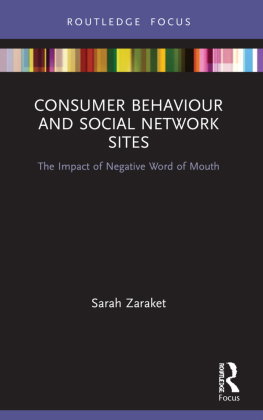
- Verlag: Taylor & Francis
- Autor: Sarah Zaraket
- Artikel-Nr.: KNV96364481
- ISBN: 9780367532864
This book provides a solid understanding of electronic word of mouth (eWOM) by taking the reader through the process of information diffusion from rumour generation in times of traditional word of mouth (WOM) to negative social eWOM and examining how consumers process it.
Consumer Behaviour and Social Network Sites tackles different themes relating to negative eWOM. Drawing on both intensive scientific research and professional examples, it bridges the gap between the academic and professional worlds. The book contrasts negative social eWOM to traditional WOM while discussing the specificities of different social networking sites in diffusing such information. It looks at why and how consumers decide to create, share and react to negative social eWOM, suggesting that there are more reasons than are commonly presumed for consumers to articulate themselves on these platforms. It also provides an appreciation of web users' behaviours with regards to negative social eWOM and how it can alter their decision-making journey.
The book concludes with several strategies and key takeaways to deal with and prevent negative social eWOM. Most books on WOM are purely professional and lack the theoretical contextualization of the issue. Moreover, they often provide insights on brand-to-consumer conversation but not consumer-to-consumer (C2C) communication. This short book provides marketing academics, students and practitioners with an important insight into these C2C communications that can potentially be harmful to brands.