






Diese Website verwendet Cookies und ähnliche Technologien. Dabei handelt es sich um kleine Textdateien, die auf eurem Computer gespeichert und ausgelesen werden. Indem ihr auf "Alles akzeptieren" klickt, stimmt ihr der Verarbeitung von Daten, der Erstellung und Verarbeitung von individuellen Nutzungsprofilen über Websites und über Partner und Geräte hinweg sowie der Übermittlung eurer Daten an Drittanbieter zu, die eure Daten teilweise in Ländern außerhalb der Europäischen Union verarbeiten (GDPR Art. 49). Einzelheiten hierzu findet ihr in den Datenschutzhinweisen. Die Daten werden für Analysen und für eigene Zwecke Dritter verwendet. Weitere Informationen, auch über die Datenverarbeitung durch Drittanbieter und die Möglichkeit des Widerrufs, findet ihr in den Einstellungen und in unseren Datenschutzhinweisen. Hier könnt ihr mit den notwendigen Tools fortfahren.
- Verlag: Taylor & Francis
- Autor: Mikiko Nishimura
- Artikel-Nr.: KNV96360937
- ISBN: 9780367504298
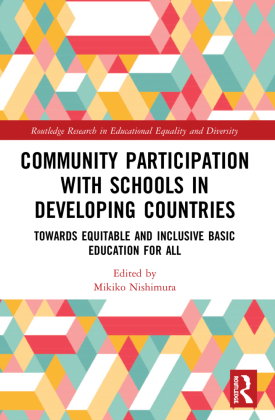
The Sustainable Development Goals (SDGs) (2016-2030) set by the United Nations in 2015 restated the importance of universal primary education for all, and specifically discuss quality, equity, and inclusion in basic education. To achieve this, the role of community has been emphasized and participation has become a "buzzword" in international development over the past several decades. Despite the growing attention to community participation in school management, previous literature has shown mixed results in terms of its actual practice and its impacts on quality, equity, and inclusion in education.
This book deepens the contextual understanding of community in developing countries and its involvement in schools in general, and its impact on quality, equity, and inclusion of school education in particular. By presenting various case studies in Asia, Africa, Latin America, and a post-conflict state in Europe, the book analyses commonalities and differences in the ways communities are involved and cast their impacts and challenges. The book contributes knowledge on the ways in which community involvement could work in developing countries, the detailed processes and factors that make community participation work in different dimensions, and remaining challenges that scholars and practitioners still need to be concerned and mindful in the field.
This book will appeal to both researchers and practitioners who are concerned about the community participation approach for the SDGs.