






Diese Website verwendet Cookies und ähnliche Technologien. Dabei handelt es sich um kleine Textdateien, die auf eurem Computer gespeichert und ausgelesen werden. Indem ihr auf "Alles akzeptieren" klickt, stimmt ihr der Verarbeitung von Daten, der Erstellung und Verarbeitung von individuellen Nutzungsprofilen über Websites und über Partner und Geräte hinweg sowie der Übermittlung eurer Daten an Drittanbieter zu, die eure Daten teilweise in Ländern außerhalb der Europäischen Union verarbeiten (GDPR Art. 49). Einzelheiten hierzu findet ihr in den Datenschutzhinweisen. Die Daten werden für Analysen und für eigene Zwecke Dritter verwendet. Weitere Informationen, auch über die Datenverarbeitung durch Drittanbieter und die Möglichkeit des Widerrufs, findet ihr in den Einstellungen und in unseren Datenschutzhinweisen. Hier könnt ihr mit den notwendigen Tools fortfahren.
- Verlag: Taylor & Francis
- Autor: Margaret Davies
- Artikel-Nr.: KNV96360917
- ISBN: 9780367651992
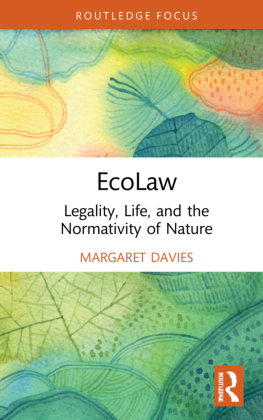
This book re-imagines law as ecolaw.
The key insight of ecological thinking, that everything is connected to everything else - at least on the earth, and possibly in the cosmos - has become a truism of contemporary theory. Taking this insight as a starting point for understanding law involves suspending theoretical certainties and boundaries. It involves suspending theory itself as a conceptual project and practicing it as an embodied and material project. Although an ecological imagining of law can be metaphorical, and can be highly imaginative and suggestive, this book shows that it is also literal. Law is part of the material 'everything' that is connected to everything else. This means that once the previous certainties of legal thinking have been dismantled, it is after all possible to think of law as 'natural' - as embedded in and emergent from a normative biophysical nature. The book proposes that there exists a natural nomos: animals, plants, and Earth systems that produce their own values and norms from which human norms and laws emerge. This book, then, proposes a new way to understand law, and pursues specific arguments to demonstrate the feasibility of law as ecolaw.
Drawing inspiration from current trends in the post-humanities, socioecological thought, and developments across the natural sciences in their specific intersections with humanities and social science disciplines, this book will appeal both to legal theorists and to others with interests in these areas.