






Diese Website verwendet Cookies und ähnliche Technologien. Dabei handelt es sich um kleine Textdateien, die auf eurem Computer gespeichert und ausgelesen werden. Indem ihr auf "Alles akzeptieren" klickt, stimmt ihr der Verarbeitung von Daten, der Erstellung und Verarbeitung von individuellen Nutzungsprofilen über Websites und über Partner und Geräte hinweg sowie der Übermittlung eurer Daten an Drittanbieter zu, die eure Daten teilweise in Ländern außerhalb der Europäischen Union verarbeiten (GDPR Art. 49). Einzelheiten hierzu findet ihr in den Datenschutzhinweisen. Die Daten werden für Analysen und für eigene Zwecke Dritter verwendet. Weitere Informationen, auch über die Datenverarbeitung durch Drittanbieter und die Möglichkeit des Widerrufs, findet ihr in den Einstellungen und in unseren Datenschutzhinweisen. Hier könnt ihr mit den notwendigen Tools fortfahren.
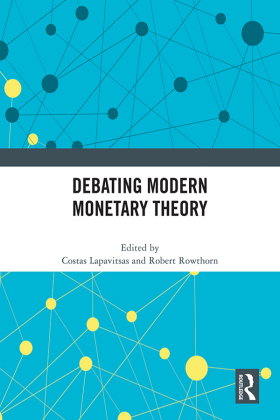
- Verlag: Taylor & Francis
- Autor: Costas Lapavitsas
- Artikel-Nr.: KNV96360531
- ISBN: 9781032249421
This book considers the theoretical and empirical claims of Modern Monetary Theory (MMT) in developed and developing countries. It is structured as a debate between leading MMT theorists and MMT critics.
MMT threw down a challenge to mainstream economics and forced it to respond, above all in the USA. This is a rare occurrence, almost unknown, for heterodox economics during the last few decades. It is not surprising, therefore, that MMT has attracted strong attention from a broad swathe of researchers. It is even less surprising that it has become the theoretical vehicle of choice for political activists opposing austerity. Its influence is remarkable and has gradually spread to other social disciplines, including even cultural theory. Furthermore, the policy responses to coronavirus by several governments, particularly the extraordinary expansion of central bank balance sheets in 2020, appears to support MMT in practice.
This volume takes into account the rising popularity of MMT and considers its theoretical claims in depth, since popularity does not necessarily equate to being right in theory. It also considers MMT claims regarding fiscal and monetary policy in view of the implications of the pandemic crisis for public spending and public debt. It is not accidental that the strongest support for MMT, in both theory and policy, is to be found in the USA, since MMT conclusions rely heavily on close institutional analysis of US government financing mechanisms.
The chapters in this book were originally published as a special issue of The Japanese Political Economy.