






Diese Website verwendet Cookies und ähnliche Technologien. Dabei handelt es sich um kleine Textdateien, die auf eurem Computer gespeichert und ausgelesen werden. Indem ihr auf "Alles akzeptieren" klickt, stimmt ihr der Verarbeitung von Daten, der Erstellung und Verarbeitung von individuellen Nutzungsprofilen über Websites und über Partner und Geräte hinweg sowie der Übermittlung eurer Daten an Drittanbieter zu, die eure Daten teilweise in Ländern außerhalb der Europäischen Union verarbeiten (GDPR Art. 49). Einzelheiten hierzu findet ihr in den Datenschutzhinweisen. Die Daten werden für Analysen und für eigene Zwecke Dritter verwendet. Weitere Informationen, auch über die Datenverarbeitung durch Drittanbieter und die Möglichkeit des Widerrufs, findet ihr in den Einstellungen und in unseren Datenschutzhinweisen. Hier könnt ihr mit den notwendigen Tools fortfahren.
- Verlag: Taylor & Francis
- Autor: Nik Hynek
- Artikel-Nr.: KNV96360517
- ISBN: 9780367492854
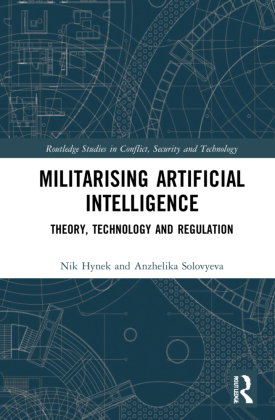
This book examines the military characteristics and potential of Artificial Intelligence (AI) in the new global revolution in military affairs.
Offering an original perspective on the utilization, imagination, and politics of AI in the context of military development and weapons regulation, the work provides a comprehensive response to the question of how we might reflect on the AI revolution in warfare and what can be said about the ways in which this has been handled. In the first part of the book, AI is accommodated, both theoretically and empirically, in the strategic context of the 'Revolution in Military Affairs' (RMA). The book offers a novel understanding of autonomous weapons as multi-layered composite systems, pointing to a complex, non-linear interplay between evolutionary and revolutionary dynamics. In the second section, the book provides an impartial analysis of the related politics and operations of power, whereby increases in military budgets and R&D of the great powers are met and countered by advocacy networks and scientists campaigning for a ban on lethal autonomous weapons. As such, it moves beyond popular caricatures of 'killer robots' and points out some of the problems which result from over-reliance on such imagery.
This book will be of much interest to students of strategic studies, critical security studies, arms control and disarmament, science and technology studies and general International Relations.