






Diese Website verwendet Cookies und ähnliche Technologien. Dabei handelt es sich um kleine Textdateien, die auf eurem Computer gespeichert und ausgelesen werden. Indem ihr auf "Alles akzeptieren" klickt, stimmt ihr der Verarbeitung von Daten, der Erstellung und Verarbeitung von individuellen Nutzungsprofilen über Websites und über Partner und Geräte hinweg sowie der Übermittlung eurer Daten an Drittanbieter zu, die eure Daten teilweise in Ländern außerhalb der Europäischen Union verarbeiten (GDPR Art. 49). Einzelheiten hierzu findet ihr in den Datenschutzhinweisen. Die Daten werden für Analysen und für eigene Zwecke Dritter verwendet. Weitere Informationen, auch über die Datenverarbeitung durch Drittanbieter und die Möglichkeit des Widerrufs, findet ihr in den Einstellungen und in unseren Datenschutzhinweisen. Hier könnt ihr mit den notwendigen Tools fortfahren.
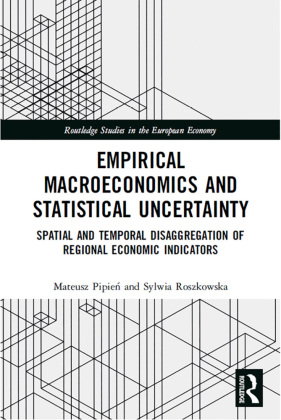
- Verlag: Taylor & Francis
- Autor: Mateusz Pipien
- Artikel-Nr.: KNV96364323
- ISBN: 9780367540784
This book addresses one of the most important research activities in empirical macroeconomics. It provides a course of advanced but intuitive methods and tools enabling the spatial and temporal disaggregation of basic macroeconomic variables and the assessment of the statistical uncertainty of the outcomes of disaggregation.
The empirical analysis focuses mainly on GDP and its growth in the context of Poland. However, all of the methods discussed can be easily applied to other countries. The approach used in the book views spatial and temporal disaggregation as a special case of the estimation of missing observations (a topic on missing data analysis). The book presents an econometric course of models of Seemingly Unrelated Regression Equations (SURE). The main advantage of using the SURE specification is to tackle the presented research problem so that it allows for the heterogeneity of the parameters describing relations between macroeconomic indicators. The book contains model specification, as well as descriptions of stochastic assumptions and resulting procedures of estimation and testing. The method also addresses uncertainty in the estimates produced. All of the necessary tests and assumptions are presented in detail. The results are designed to serve as a source of invaluable information making regional analyses more convenient and - more importantly - comparable. It will create a solid basis for making conclusions and recommendations concerning regional economic policy in Poland, particularly regarding the assessment of the economic situation.
This is essential reading for academics, researchers, and economists with regional analysis as their field of expertise, as well as central bankers and policymakers.