






Diese Website verwendet Cookies und ähnliche Technologien. Dabei handelt es sich um kleine Textdateien, die auf eurem Computer gespeichert und ausgelesen werden. Indem ihr auf "Alles akzeptieren" klickt, stimmt ihr der Verarbeitung von Daten, der Erstellung und Verarbeitung von individuellen Nutzungsprofilen über Websites und über Partner und Geräte hinweg sowie der Übermittlung eurer Daten an Drittanbieter zu, die eure Daten teilweise in Ländern außerhalb der Europäischen Union verarbeiten (GDPR Art. 49). Einzelheiten hierzu findet ihr in den Datenschutzhinweisen. Die Daten werden für Analysen und für eigene Zwecke Dritter verwendet. Weitere Informationen, auch über die Datenverarbeitung durch Drittanbieter und die Möglichkeit des Widerrufs, findet ihr in den Einstellungen und in unseren Datenschutzhinweisen. Hier könnt ihr mit den notwendigen Tools fortfahren.
- Verlag: Taylor & Francis
- Autor: Lisa Schwarz
- Artikel-Nr.: KNV96360590
- ISBN: 9781138579729
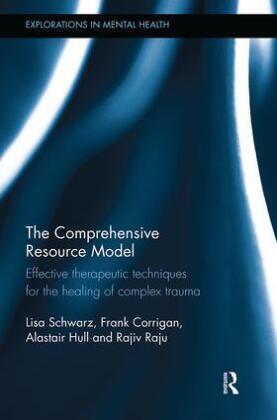
Traditional methods employed in psychotherapy have limited effectiveness when it comes to healing the psychological effects of trauma, in particular, complex trauma. While a client may seem to make significant breakthroughs in understanding their feelings and experiences on a rational level by talking with a therapist, this will make no difference to their post-traumatic symptoms if the midbrain is unable to modulate its activity in response. The Comprehensive Resource Model argues for a novel therapeutic approach, which uniquely bridges neuroscience and spirituality through a combination of somatic therapy, traditional psychotherapy, and indigenous healing concepts to provide effective relief to survivors of trauma.
The Comprehensive Resource Model was developed in response to the need for a streamlined, integrative therapeutic model; one which engages a scaffolding of neurobiological resources in many brain structures simultaneously in order for clients to be fully embodied and conscious in the present moment while processing their traumatic material. All three phases of trauma therapy: resourcing, processing, and integration are done simultaneously. Demonstrating a nested model and employing brain and body-based physiological safety as the foundation of healing, chapters describe three primary categories of targeted processing: implicit and explicit survival terror, 'Little T Truths', and 'Big T Truths', all of which contribute to thorough healing of complex trauma and an expansion into higher states of consciousness and embodiment of the essential core self.
This book describes the development and benefits of this pioneering new approach to trauma therapy. As such, it will be of key interest to academics, researchers and postgraduate students in the fields of psychiatry, psychotherapy, psychology and trauma studies. It will also appeal to practising therapists, psychiatrists, psychologists, psychiatric nurses, and to others involved in the treatment or management of patients with complex trauma disorders.