






Diese Website verwendet Cookies und ähnliche Technologien. Dabei handelt es sich um kleine Textdateien, die auf eurem Computer gespeichert und ausgelesen werden. Indem ihr auf "Alles akzeptieren" klickt, stimmt ihr der Verarbeitung von Daten, der Erstellung und Verarbeitung von individuellen Nutzungsprofilen über Websites und über Partner und Geräte hinweg sowie der Übermittlung eurer Daten an Drittanbieter zu, die eure Daten teilweise in Ländern außerhalb der Europäischen Union verarbeiten (GDPR Art. 49). Einzelheiten hierzu findet ihr in den Datenschutzhinweisen. Die Daten werden für Analysen und für eigene Zwecke Dritter verwendet. Weitere Informationen, auch über die Datenverarbeitung durch Drittanbieter und die Möglichkeit des Widerrufs, findet ihr in den Einstellungen und in unseren Datenschutzhinweisen. Hier könnt ihr mit den notwendigen Tools fortfahren.
- Verlag: Taylor & Francis
- Autor: Kenneth R. Westphal
- Artikel-Nr.: KNV96364366
- ISBN: 9780367535339
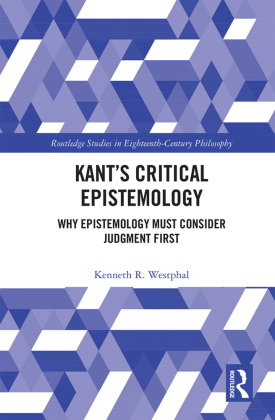
This book assesses and defends Kant's Critical epistemology, and the rich yet neglected resources it provides for understanding and resolving fundamental issues regarding human experience, perceptual judgment, empirical knowledge and cognitive sciences.
Kenneth Westphal first examines Kant's methods and strategies for examining human sensory-perceptual experience, and then examines Kant's central, proper, and subtle attention to judgment, and so to the humanly possible valid use of concepts and principles to judge particulars we confront. This provides a comprehensive account of Kant's anti-Cartesianism, the integrity of his three principles of causal judgment, and Kant's account of disciminatory perceptual-motor behaviour, including both sensory reafference and perceptual affordances. Westphal then defends the significance of Kant's subtle and illuminating account of causal judgment for three main philosophical domains: history and philosophy of science, theory of action and human freedom, and philosophy of mind.
Kant's Critical Epistemology will appeal to researchers and advanced students interested in Kant and the relations of his thought to contemporary philosophical debates and to the sciences of the mind.