






Diese Website verwendet Cookies und ähnliche Technologien. Dabei handelt es sich um kleine Textdateien, die auf eurem Computer gespeichert und ausgelesen werden. Indem ihr auf "Alles akzeptieren" klickt, stimmt ihr der Verarbeitung von Daten, der Erstellung und Verarbeitung von individuellen Nutzungsprofilen über Websites und über Partner und Geräte hinweg sowie der Übermittlung eurer Daten an Drittanbieter zu, die eure Daten teilweise in Ländern außerhalb der Europäischen Union verarbeiten (GDPR Art. 49). Einzelheiten hierzu findet ihr in den Datenschutzhinweisen. Die Daten werden für Analysen und für eigene Zwecke Dritter verwendet. Weitere Informationen, auch über die Datenverarbeitung durch Drittanbieter und die Möglichkeit des Widerrufs, findet ihr in den Einstellungen und in unseren Datenschutzhinweisen. Hier könnt ihr mit den notwendigen Tools fortfahren.
- Verlag: Taylor & Francis
- Autor: Harald Atmanspacher
- Artikel-Nr.: KNV96360642
- ISBN: 9781032212647
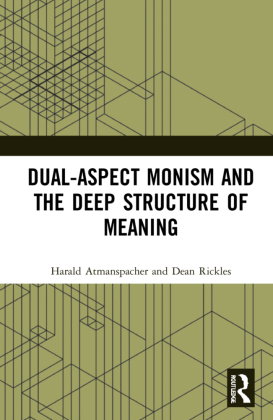
Dual-Aspect Monism and the Deep Structure of Meaning investigates the metaphysical position of dual-aspect monism, with particular emphasis on the concept of meaning as a fundamental feature of the fabric of reality. As an alternative to other positions - mainly dualism, physicalism, idealism - that have been proposed to understand consciousness and its place in nature, the decompositional version of dual-aspect monism considers the mental and the physical as two aspects of one underlying undivided reality that is psychophysically neutral. Inspired by analogies with modern physics and driven by its conceptual problems, Wolfgang Pauli, Carl Gustav Jung, Arthur Eddington, John Wheeler, David Bohm, and Basil Hiley are the originators of the approaches studied. A radically novel common theme in their approaches is the constitutive role of meaning and its deep structure, relating the mental and the physical to a psychophysically neutral base.The authors reconstruct the formal structure of these approaches, and compare their conceptual emphases as well as their relative strengths and weaknesses. They also address a number of challenging themes for current and future interdisciplinary research, both theoretical and empirical, that arise from the presented frameworks of thinking.
Dual-Aspect Monism and the Deep Structure of Meaning will be of interest to researchers and advanced students working in consciousness studies, philosophy of mind, philosophy of science, philosophy of physics, metaphysics, and the history of 20th-century philosophy and physics.