






Diese Website verwendet Cookies und ähnliche Technologien. Dabei handelt es sich um kleine Textdateien, die auf eurem Computer gespeichert und ausgelesen werden. Indem ihr auf "Alles akzeptieren" klickt, stimmt ihr der Verarbeitung von Daten, der Erstellung und Verarbeitung von individuellen Nutzungsprofilen über Websites und über Partner und Geräte hinweg sowie der Übermittlung eurer Daten an Drittanbieter zu, die eure Daten teilweise in Ländern außerhalb der Europäischen Union verarbeiten (GDPR Art. 49). Einzelheiten hierzu findet ihr in den Datenschutzhinweisen. Die Daten werden für Analysen und für eigene Zwecke Dritter verwendet. Weitere Informationen, auch über die Datenverarbeitung durch Drittanbieter und die Möglichkeit des Widerrufs, findet ihr in den Einstellungen und in unseren Datenschutzhinweisen. Hier könnt ihr mit den notwendigen Tools fortfahren.
- Verlag: Taylor & Francis
- Autor: Jobst Landgrebe
- Artikel-Nr.: KNV96364405
- ISBN: 9781032309934
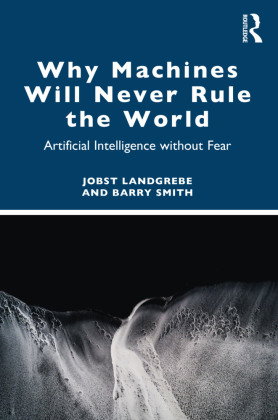
The book's core argument is that an artificial intelligence that could equal or exceed human intelligence-sometimes called artificial general intelligence (AGI)-is for mathematical reasons impossible. It offers two specific reasons for this claim:
- Human intelligence is a capability of a complex dynamic system-the human brain and central nervous system.
- Systems of this sort cannot be modelled mathematically in a way that allows them to operate inside a computer.
In supporting their claim, the authors, Jobst Landgrebe and Barry Smith, marshal evidence from mathematics, physics, computer science, philosophy, linguistics, and biology, setting up their book around three central questions: What are the essential marks of human intelligence? What is it that researchers try to do when they attempt to achieve "artificial intelligence" (AI)? And why, after more than 50 years, are our most common interactions with AI, for example with our bank's computers, still so unsatisfactory?
Landgrebe and Smith show how a widespread fear about AI's potential to bring about radical changes in the nature of human beings and in the human social order is founded on an error. There is still, as they demonstrate in a final chapter, a great deal that AI can achieve which will benefit humanity. But these benefits will be achieved without the aid of systems that are more powerful than humans, which are as impossible as AI systems that are intrinsically "evil" or able to "will" a takeover of human society.