






Diese Website verwendet Cookies und ähnliche Technologien. Dabei handelt es sich um kleine Textdateien, die auf eurem Computer gespeichert und ausgelesen werden. Indem ihr auf "Alles akzeptieren" klickt, stimmt ihr der Verarbeitung von Daten, der Erstellung und Verarbeitung von individuellen Nutzungsprofilen über Websites und über Partner und Geräte hinweg sowie der Übermittlung eurer Daten an Drittanbieter zu, die eure Daten teilweise in Ländern außerhalb der Europäischen Union verarbeiten (GDPR Art. 49). Einzelheiten hierzu findet ihr in den Datenschutzhinweisen. Die Daten werden für Analysen und für eigene Zwecke Dritter verwendet. Weitere Informationen, auch über die Datenverarbeitung durch Drittanbieter und die Möglichkeit des Widerrufs, findet ihr in den Einstellungen und in unseren Datenschutzhinweisen. Hier könnt ihr mit den notwendigen Tools fortfahren.
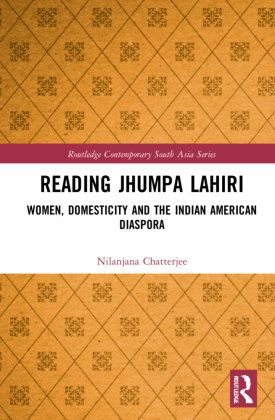
- Verlag: Taylor & Francis
- Autor: Nilanjana Chatterjee
- Artikel-Nr.: KNV96360701
- ISBN: 9781032081571
This book is an innovative and rigorous study of Jhumpa Lahiri's Indian American female characters' lived and imagined diasporic house space, using domesticity and the house as an analytical tool to explore their hidden domestic spaces.
The book explores how the house as a spatial construct, shares a symbiotic relationship with its inhabitants, and through their implicit and explicit response to various parts of their diasporic house space, interprets their maladies, limitations and opportunities. Indian American diasporic women, especially homemakers, have long been grappling with issues of socio-cultural invisibility as they have no other space to interact with except their houses in the hostland, now more than ever, during the global corona crisis. A reading of this multi-layered relationship between houses and their women will help readers understand not only the political, intellectual, emotional and sexual dispositions of middleclass Indian women in America, but also social, cultural and economic positions they occupy within the hostland. The book shows the represented domestic interstices and looks at them as signifiers of distinct individual trajectories, wherein lies embedded the women inhabitants' oppositions beneath the acceptance of normative Indian family values in diaspora. It also offers elemental insights into ways in which migration acts as an opportunity for establishing new, often hybridized, identities, for which it is important to realise their connections with their house space.
Presenting an alternative methodology for reading real and imagined lives of women in Indian American diaspora, the book proposes an unconventional mode of understanding diasporic realities and representations in cultural studies that is not readily apparent. It will be of interest to researchers in the field of South Asian Studies, Diaspora Studies, Migration Studies, Culture Studies, Feminist Writings, Gender Studies and Asian Literature.
Foreword by Bill Ashcroft