






Diese Website verwendet Cookies und ähnliche Technologien. Dabei handelt es sich um kleine Textdateien, die auf eurem Computer gespeichert und ausgelesen werden. Indem ihr auf "Alles akzeptieren" klickt, stimmt ihr der Verarbeitung von Daten, der Erstellung und Verarbeitung von individuellen Nutzungsprofilen über Websites und über Partner und Geräte hinweg sowie der Übermittlung eurer Daten an Drittanbieter zu, die eure Daten teilweise in Ländern außerhalb der Europäischen Union verarbeiten (GDPR Art. 49). Einzelheiten hierzu findet ihr in den Datenschutzhinweisen. Die Daten werden für Analysen und für eigene Zwecke Dritter verwendet. Weitere Informationen, auch über die Datenverarbeitung durch Drittanbieter und die Möglichkeit des Widerrufs, findet ihr in den Einstellungen und in unseren Datenschutzhinweisen. Hier könnt ihr mit den notwendigen Tools fortfahren.
- Verlag: Taylor & Francis
- Autor: Kyla Tienhaara
- Artikel-Nr.: KNV96360691
- ISBN: 9780367628048
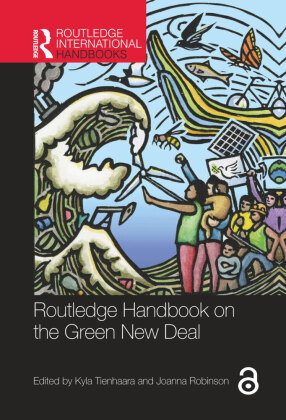
In recent years, the Green New Deal has moved from relative obscurity to front and centre of policy discussions and public debates about how to respond to the climate crisis. It has been credited with radically changing the nature of the conversation on climate change and with re-energizing the environmental movement at a critical time. All Green New Deal proposals share an emphasis on the need for governments (rather than markets) to lead the energy transition. However, they differ in other respects. This Handbook analyses the fundamentals underlying all Green New Deals as well as exploring national and regional variations.
It is divided into three parts. The first part examines the political economy of the Green New Deal focussing not just on how proposals will be costed but also on opportunities for a fundamental transformation of both national economies and the global economic system. The second part explores issues of justice, which are central to many Green New Deal proposals, including Indigenous rights, racial and gender equity, and justice for the Global South. In the third part, authors detail case studies of Green New Deal proposals and plans at the local, national, and regional level.
This book will be an invaluable research and reference volume for students and scholars in economics, politics, sociology, geography, and environmental studies. It should also be of interest to those actively involved in climate and environmental policymaking.