






Diese Website verwendet Cookies und ähnliche Technologien. Dabei handelt es sich um kleine Textdateien, die auf eurem Computer gespeichert und ausgelesen werden. Indem ihr auf "Alles akzeptieren" klickt, stimmt ihr der Verarbeitung von Daten, der Erstellung und Verarbeitung von individuellen Nutzungsprofilen über Websites und über Partner und Geräte hinweg sowie der Übermittlung eurer Daten an Drittanbieter zu, die eure Daten teilweise in Ländern außerhalb der Europäischen Union verarbeiten (GDPR Art. 49). Einzelheiten hierzu findet ihr in den Datenschutzhinweisen. Die Daten werden für Analysen und für eigene Zwecke Dritter verwendet. Weitere Informationen, auch über die Datenverarbeitung durch Drittanbieter und die Möglichkeit des Widerrufs, findet ihr in den Einstellungen und in unseren Datenschutzhinweisen. Hier könnt ihr mit den notwendigen Tools fortfahren.
- Verlag: Peter Lang
- Autor: Massimo Arcangeli
- Artikel-Nr.: KNV96415312
- ISBN: 9782875747426
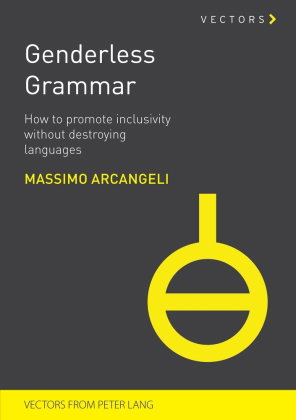
Attempts to conceal grammatical gender, dictated by the "inclusive" desire to overcome the simple distinction between masculine and feminine (gender binarism) and make room for the neutral, affect the national languagesof a variety of Western countries with increasing frequency and intensity, with the risk of weakening or compromising the functioning of the languages' supporting structures. A grammatical innovation has a very different impact from a neologism, and when that innovation, under the excuse of inclusion, ends up infiltrating a public act, or any other text issued or produced by a public entity, penetrating it in a pervasive way, the institutional endorsement should set off the alarm bells. In our case, simplicistically overlapping two levels that must instead be kept distinct - one "structural" (technical-linguistic) and the other "superstructural" (socio-cultural) - means that, in the growth economy of an entire community of speakers and writers, the structures of an idiom, above all if stratified over time, are bent to accommodate the desires of those who, against all logic and the most elementary common sense, expect immediate changes that would upset or crack the linguistic system. This ends up making even the simple decodingof information difficult.