






Diese Website verwendet Cookies und ähnliche Technologien. Dabei handelt es sich um kleine Textdateien, die auf eurem Computer gespeichert und ausgelesen werden. Indem ihr auf "Alles akzeptieren" klickt, stimmt ihr der Verarbeitung von Daten, der Erstellung und Verarbeitung von individuellen Nutzungsprofilen über Websites und über Partner und Geräte hinweg sowie der Übermittlung eurer Daten an Drittanbieter zu, die eure Daten teilweise in Ländern außerhalb der Europäischen Union verarbeiten (GDPR Art. 49). Einzelheiten hierzu findet ihr in den Datenschutzhinweisen. Die Daten werden für Analysen und für eigene Zwecke Dritter verwendet. Weitere Informationen, auch über die Datenverarbeitung durch Drittanbieter und die Möglichkeit des Widerrufs, findet ihr in den Einstellungen und in unseren Datenschutzhinweisen. Hier könnt ihr mit den notwendigen Tools fortfahren.
- Verlag: Springer, Berlin
- Autor: Florencia Montagnini
- Artikel-Nr.: KNV96419248
- ISBN: 9783030922368
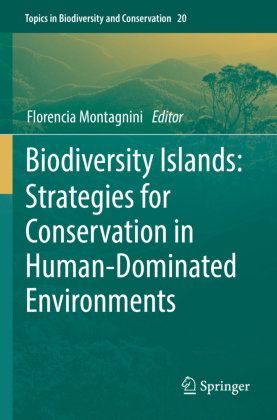
This book is intended to provide an overview for the identification and establishment of biodiversity islands. It presents examples and case studies where the biodiversity islands approach is being used in a variety of locations and contexts worldwide. It will contribute to design parameters on appropriate sizing and spatial distribution of biodiversity islands in order to be effective in conservation and regeneration across the landscape, using integrated landscape management approaches. This book is essential given the current worldwide trend of habitat destruction and the need to preserve biodiversity and its values.
The chapters are organized in five sections. The first section provides the introduction. Section 2,3 and 4 discuss the challenges and alternatives of establishment and management, case studies across the globe, safeguarding of the environmental, economic, and social benefits, and the final section offers a conclusion.
The contributing authors present views from the academic, the practitioner and the policymaker perspectives, offering alternatives and suggestions for promoting strategies that support biodiversity conservation through intentionally designed frameworks for sustainable forest landscapes.
Readers will discover suggestions and concrete examples that can be used by a variety of stakeholders in various settings throughout the world.
This book is useful to researchers, farmers, foresters, landowners, land managers, city planners, and policy makers alike.