






Diese Website verwendet Cookies und ähnliche Technologien. Dabei handelt es sich um kleine Textdateien, die auf eurem Computer gespeichert und ausgelesen werden. Indem ihr auf "Alles akzeptieren" klickt, stimmt ihr der Verarbeitung von Daten, der Erstellung und Verarbeitung von individuellen Nutzungsprofilen über Websites und über Partner und Geräte hinweg sowie der Übermittlung eurer Daten an Drittanbieter zu, die eure Daten teilweise in Ländern außerhalb der Europäischen Union verarbeiten (GDPR Art. 49). Einzelheiten hierzu findet ihr in den Datenschutzhinweisen. Die Daten werden für Analysen und für eigene Zwecke Dritter verwendet. Weitere Informationen, auch über die Datenverarbeitung durch Drittanbieter und die Möglichkeit des Widerrufs, findet ihr in den Einstellungen und in unseren Datenschutzhinweisen. Hier könnt ihr mit den notwendigen Tools fortfahren.
- Verlag: Springer, Berlin
- Autor: Hope, Sr., Kempe Ronald
- Artikel-Nr.: KNV96430952
- ISBN: 9783031322280
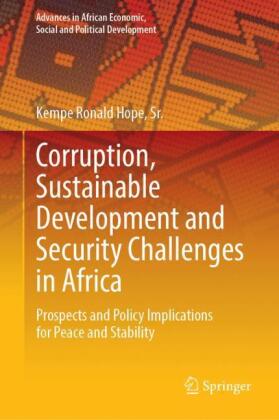
This book sheds light on Africa's development performance and dynamics arising from the interface between corruption and sustainable development on the one hand and the challenges that poses for peace, security and stability. Corruption also contributes to the spread of terrorism and violent extremism. Pervasive corruption networks often include politicians, civil servants working at all levels of state institutions, representatives of the private sector and members of crime syndicates. The consequences of corruption are detrimental in many aspects, such as undermining governments' ability to serve public interests and eroding public trust in democratic processes.
Presenting empirical evidence, the book explains why corruption and the looting of staggering amounts of national assets undermine the achievement of the Sustainable Development Goals (SDGs) and has a negative impact on peace, stability, security, the rule of law, gender equality, the environment and human rights. This makes the book a must-read for students, researchers and scholars of political science, international relations, and economics in general, as well as African studies, development studies, and security sector studies in particular, covering issues and themes on corruption, governance, socio-economic sustainable development, public administration and management, policing in an international context, police reform, and security sector reform. It will also serve as a helpful resource for policy-makers interested in a better understanding of the connection between corruption, sustainable development, and security challenges in Sub-Saharan Africa.