






Diese Website verwendet Cookies und ähnliche Technologien. Dabei handelt es sich um kleine Textdateien, die auf eurem Computer gespeichert und ausgelesen werden. Indem ihr auf "Alles akzeptieren" klickt, stimmt ihr der Verarbeitung von Daten, der Erstellung und Verarbeitung von individuellen Nutzungsprofilen über Websites und über Partner und Geräte hinweg sowie der Übermittlung eurer Daten an Drittanbieter zu, die eure Daten teilweise in Ländern außerhalb der Europäischen Union verarbeiten (GDPR Art. 49). Einzelheiten hierzu findet ihr in den Datenschutzhinweisen. Die Daten werden für Analysen und für eigene Zwecke Dritter verwendet. Weitere Informationen, auch über die Datenverarbeitung durch Drittanbieter und die Möglichkeit des Widerrufs, findet ihr in den Einstellungen und in unseren Datenschutzhinweisen. Hier könnt ihr mit den notwendigen Tools fortfahren.
- Verlag: Springer, Berlin
- Autor: Andreas Maur
- Artikel-Nr.: KNV96436458
- ISBN: 9783658416195
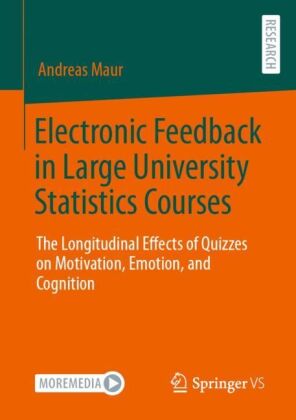
Digital tools and pedagogies in public higher education are unfolding their potential by providing large groups of students with automated, continuous learning and feedback opportunities. However, most of the existing studies are cross-sectional, unidirectional and focus on a limited selection of relevant target variables and instructional features. In a field study, Andreas Maur used longitudinal latent structural equation modelling with a large sample of students to analyse the interrelations between formative feedback from electronic quizzes and different facets of the control value theory of achievement emotions. The results suggest that regular quizzes most consistently improve self-efficacy, anxiety, effort, course enjoyment, and hopelessness over time. Only feedback effects related to intrinsic motivation were consistently less effective for female and less proficient students, and for students in traditional versus flipped classrooms. These findings highlight the need to scale up formative feedback in higher education and to cultivate feedback systems with higher levels of sophistication, adaptability, and gamification mechanics.