






Diese Website verwendet Cookies und ähnliche Technologien. Dabei handelt es sich um kleine Textdateien, die auf eurem Computer gespeichert und ausgelesen werden. Indem ihr auf "Alles akzeptieren" klickt, stimmt ihr der Verarbeitung von Daten, der Erstellung und Verarbeitung von individuellen Nutzungsprofilen über Websites und über Partner und Geräte hinweg sowie der Übermittlung eurer Daten an Drittanbieter zu, die eure Daten teilweise in Ländern außerhalb der Europäischen Union verarbeiten (GDPR Art. 49). Einzelheiten hierzu findet ihr in den Datenschutzhinweisen. Die Daten werden für Analysen und für eigene Zwecke Dritter verwendet. Weitere Informationen, auch über die Datenverarbeitung durch Drittanbieter und die Möglichkeit des Widerrufs, findet ihr in den Einstellungen und in unseren Datenschutzhinweisen. Hier könnt ihr mit den notwendigen Tools fortfahren.
- Verlag: Springer, Berlin
- Autor: Robert F. van Brederode
- Artikel-Nr.: KNV96483112
- ISBN: 9789811910944
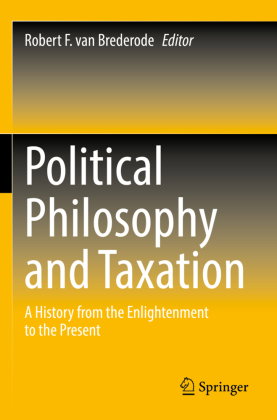
This book explores how taxation is related to the role of the state and its relationship with its constituents, the concept of private property rights, the concepts of societal fairness and justice, and the battle between the individual and the collective. This book appeals to students and scholars who want to know how philosophers in the past and present think about taxation, and how their thinking has developed through cross-influencing. There exists no comprehensive study providing such an overview.
This book is a foundational study on the philosophical justification of taxation (qualitative aspect) and the normative qualifications required of tax law to constitute tax that is just and fair (distributive or quantitative aspect). The latter includes evaluation of what type of tax is morally correct or acceptable to realize distributive justice. This book covers periods from the Enlightenment era until the present. The philosophers are grouped together in schools of thought and each chapter except for chapter 1 and chapter 13, are is dedicated to a specific philosophical school.
Moreover, this book aims to provide an overview of each school of thinking and the individual philosophers, including placing them in the context of their times. The book has particular importance as the study of taxation is an underdeveloped area of political and legal philosophy.