






Diese Website verwendet Cookies und ähnliche Technologien. Dabei handelt es sich um kleine Textdateien, die auf eurem Computer gespeichert und ausgelesen werden. Indem ihr auf "Alles akzeptieren" klickt, stimmt ihr der Verarbeitung von Daten, der Erstellung und Verarbeitung von individuellen Nutzungsprofilen über Websites und über Partner und Geräte hinweg sowie der Übermittlung eurer Daten an Drittanbieter zu, die eure Daten teilweise in Ländern außerhalb der Europäischen Union verarbeiten (GDPR Art. 49). Einzelheiten hierzu findet ihr in den Datenschutzhinweisen. Die Daten werden für Analysen und für eigene Zwecke Dritter verwendet. Weitere Informationen, auch über die Datenverarbeitung durch Drittanbieter und die Möglichkeit des Widerrufs, findet ihr in den Einstellungen und in unseren Datenschutzhinweisen. Hier könnt ihr mit den notwendigen Tools fortfahren.
- Verlag: Springer, Berlin
- Autor: Jianfeng Xu
- Artikel-Nr.: KNV96647581
- ISBN: 9789811923845
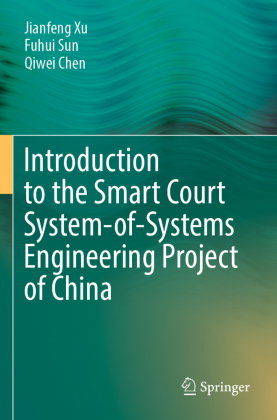
This book discusses the overall development and use of smart courts from the perspective of system-of-systems engineering (SoSE) and its methodology, analyzes the relationships between the components, structures, environments, and functions of various systems, and illustrates the basic approaches to system design, specification, integration, operation and management. As the general introductory book of the China Smart Court Development Series, this book provides an overview of the development of Chinese people's courts in the application of information technology over the past two decades and outlines the key areas of exploration in the Smart Court SoSe project centered on the development practices during the 13th Five-Year Plan period. It also forecasts the future development and evolution of the smart court information system. The key topics introduced in the book, including the overall design of complex information systems, integrated interconnectionnetworks-based system integration, judicial big data quality control and analytics services, various types of AI-enabled judicial services, quality and efficiency-oriented operation and maintenance services for large-scale information systems, etc., all came from the basic research of information science and theories, as well as the systems engineering practices of the Smart Court SoSe project. They not only reflect the latest findings on systems engineering and architecture methods in China and overseas, but also reveal many innovative approaches to SoSE methods and paradigms, which can be used for the design and continued development of smart courts at a new and higher starting point. It is believed that they can also serve as good examples and reference points for the development in IT application and complex information systems engineering in other sectors.