






Diese Website verwendet Cookies und ähnliche Technologien. Dabei handelt es sich um kleine Textdateien, die auf eurem Computer gespeichert und ausgelesen werden. Indem ihr auf "Alles akzeptieren" klickt, stimmt ihr der Verarbeitung von Daten, der Erstellung und Verarbeitung von individuellen Nutzungsprofilen über Websites und über Partner und Geräte hinweg sowie der Übermittlung eurer Daten an Drittanbieter zu, die eure Daten teilweise in Ländern außerhalb der Europäischen Union verarbeiten (GDPR Art. 49). Einzelheiten hierzu findet ihr in den Datenschutzhinweisen. Die Daten werden für Analysen und für eigene Zwecke Dritter verwendet. Weitere Informationen, auch über die Datenverarbeitung durch Drittanbieter und die Möglichkeit des Widerrufs, findet ihr in den Einstellungen und in unseren Datenschutzhinweisen. Hier könnt ihr mit den notwendigen Tools fortfahren.
- Verlag: Springer, Berlin
- Autor: Hamdi A. Zurqani
- Artikel-Nr.: KNV96647720
- ISBN: 9783030978129
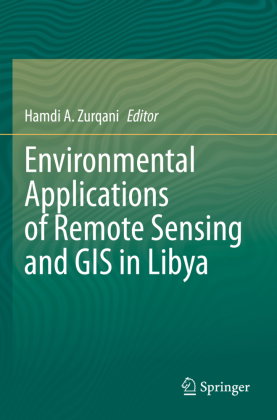
This book addresses the environmental challenges that Libya and similar countries in the regions are currently facing. Each chapter of this book provides a methodology using remote sensing (RS) and geographical information systems (GIS) dealing with one of these environmental challenges such as monitoring and mapping soil salinity and prediction of soil properties, monitoring and mapping of land degradation, spatiotemporal land use/cover, agricultural drought monitoring, hydrological applications such as spatial rainfall distribution, surface runoff, geo-morphometric analysis, flood hazard assessment and mapping, hydrologic and hydraulic modeling, pollution hazard assessment, and climate-related geophysical processes. This book also assesses the impacts of climate change on natural resources using both RS and GIS, as well as other applications, covering different parts of Libya.
This book is beneficial for graduate students, researchers, policy planners, and stakeholders in Libya as well as other countries that share similar environmental issues. Also, the methodologies followed in the book's chapters can be applied to any other regions around the world with similar landscapes and climatic conditions.